

People have been saying that “SEO is dead” for a long time now. Today we know that SEO isn’t dead, but it is being transformed. And this transformation is down to the arrival of generative AI (Google’s AI Overviews and AI Mode, ChatGPT, Gemini, Claude, Perplexity…).
Traditional SEO has now been joined by GEO (generative engine optimisation). In other words, the same old SEO… backlinks and content quality, but with brand signals (branded search, online reputation, brand mentions) carrying even more weight than before.
That’s why, to sell online, you need to optimise your shop’s On Page SEO, Off Page SEO and technical SEO… and now, on top of that, get your ecommerce ready so that AI understands it and recommends it.
Stick around! By the end of this article you’ll know how to optimise your ecommerce SEO and GEO, with the aim of generating organic traffic and sales.
Ecommerce SEO: what is it and why does it matter for your online shop?
Ecommerce SEO covers the actions that improve your online shop’s visibility on Google (and, these days, in AI too), so that you appear when someone searches for what you sell. Its ultimate goal is to turn those searches into sales by attracting qualified traffic with purchase intent.
When your potential customers search on Google and your online shop isn’t visible, it’s very hard for them to find it and buy. That’s why working on your online shop’s visibility and rankings is the first step towards selling your products or services.
Unlike other websites, the search intent an ecommerce site appears for is transactional: it isn’t just after visits, but qualified visits that turn into sales. And almost everything revolves around three types of page that you should be clear about from the outset:
- Categories (and subcategories): Product listings, where the keywords with the highest search volume are concentrated.
- Product pages: The most transactional part, where users make up their minds and buy.
- Blog articles: Informational content that attracts users and supports them throughout the buying process.
What has changed in 2026 is that “appearing” no longer happens only in the ten blue links. Your brand now also competes to appear in AI answers. In other words, you need to optimise your online shop to appear in AI, which is the same as implementing GEO for ecommerce strategies. It’s worth stressing that you need to work hard on what is said about you.
Tip: ask ChatGPT what customers think of your brand to find out how you are really perceived.
On Page SEO
On Page SEO is the optimisation carried out within your ecommerce site, covering keyword analysis, shop structure, content, image optimisation, interlinking… All with the aim of improving your shop’s rankings so it appears in Google’s top positions and in AI answers.
Keyword research as a key part of ecommerce SEO
Keyword research is an investigation into the search terms that are relevant to your business. It’s a very important step in On Page SEO because, as well as defining which keywords will generate business for you, it will give you information about the competition in your sector.
For example, if your shop sells “gourmet preserved vegetables”, run that search and look at the top results: you’ll see the main brands (ecommerce sites) selling those products. Those sites are your competition.
Using an SEO tool, analyse their domain to find out which keywords they rank for that your site doesn’t, and you’ll have a reference point to start working on your keywords and content.
The Chrome extension “Amazon Suggestion” also gives you ideas for keywords related to your main search.
Don’t settle for the most generic, highest-volume terms, which tend to be monopolised by big brands (Amazon, Decathlon, El Corte Inglés, Leroy Merlin…). Go for long-tail keywords: more specific, with clear purchase intent. They get fewer searches, but they are easier to rank for and convert better.
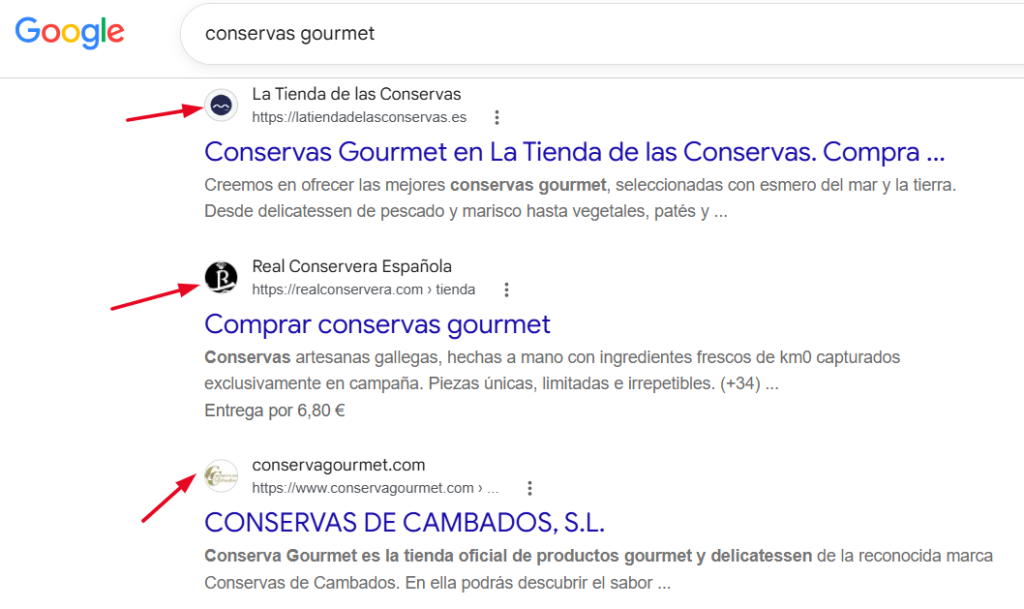
You also need to decide which type of page will target each keyword based on its search intent. Transactional keywords go to product and category pages; informational ones go to the blog. Not sure whether a keyword belongs to a category or the blog? Search for it yourself on Google and see what the search engine prioritises; that will tell you what type of content to create. As you can see in the image, the search “gourmet preserves” brings up online shops.
We’ve been talking about entities for years, yet we kept working on the exact-match keyword. Today, both Google and AI reason and understand the context of a page rather than simply checking how many times a term is repeated. You no longer need to create ultra-specific landing pages or force the keyword into every heading. If your content demonstrates something, AI will infer it and value it.
A bit clearer now? Great, let’s keep going!
Content and search intent
Based on that initial keyword analysis, work on your content. Include the keywords from your research and their related terms in your product descriptions to give your copy semantic context.
Google already interprets search intent, so, sticking with the same example, when you search for “gourmet preserved vegetables” it doesn’t rely on that keyword alone, but shows related products such as “gourmet tuna” or “gourmet mussels”, because it understands that the user is looking for gourmet products (even if they aren’t vegetables).
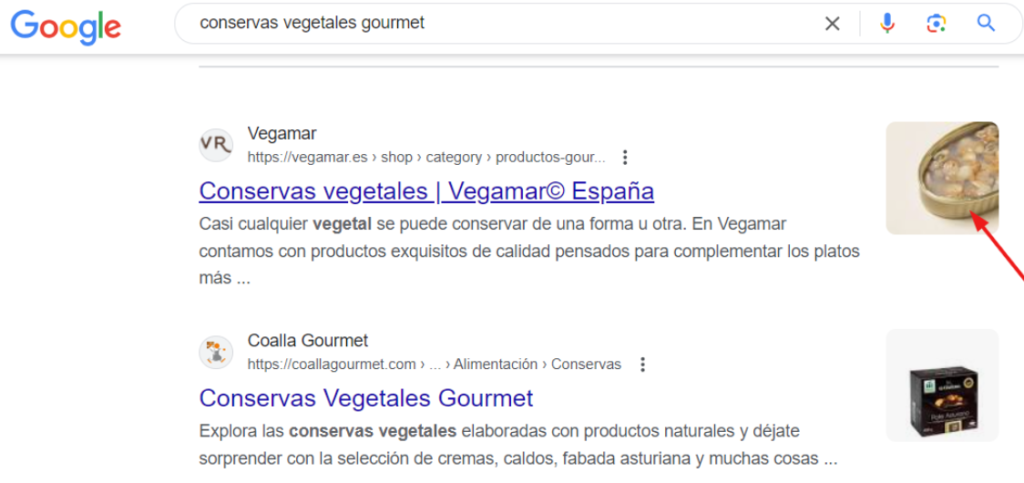
The importance of a blog for an online shop
Many people who have written the blog off are mistaken, because it is still essential, and here’s why:
- It’s what gives your online shop topic authority, and any AI will give you visibility based on the authority and rankings you already have.
- It’s the best place to set out those angles for each user profile and convince people why your product or brand is better than another. What’s more, a good article increases dwell time and lets you target informational terms without overloading your product pages.
For example: sticking with the “gourmet preserves” example, if you sell artichokes, you can write an informational article about the properties of artichokes and include links to the artichokes (a product in your online shop) so that users have the option of buying them.
Images and videos
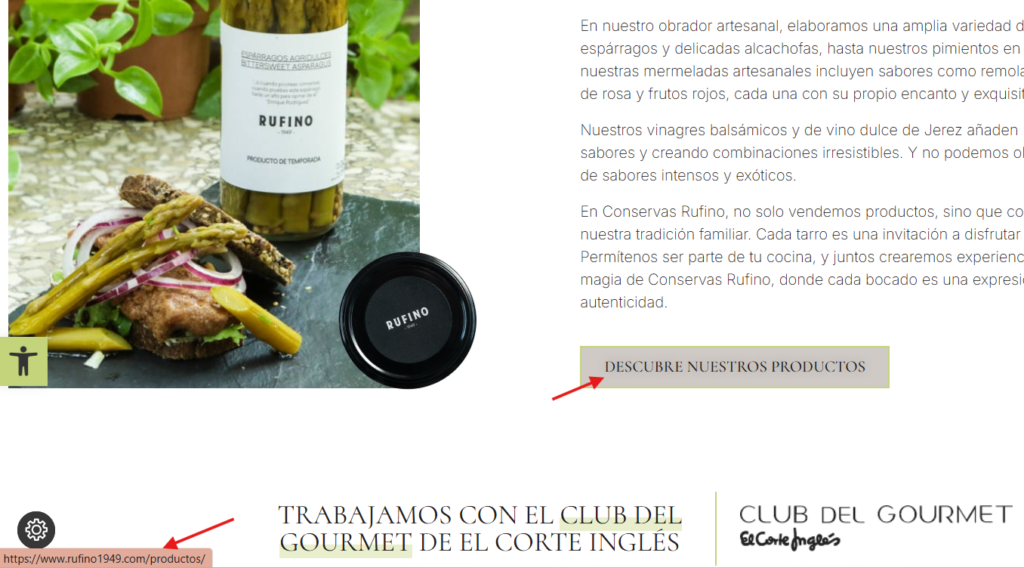
In ecommerce, the higher the quality of your images, the better. It increases return on investment and reduces the cart abandonment rate. The idea is to show users, in the best possible way, the product they are going to receive.
Always include real images (how a garment hangs, the size of an earring, a macro photo of the fabric) and don’t forget keywords in the ALT attribute. Optimise image file sizes before uploading them: ecommerce sites accumulate huge numbers of them and they slow down loading speed.
And here’s a very interesting fact to bear in mind: video has become a key asset for appearing in AI. According to an Ahrefs analysis of more than 3 million queries, YouTube is now one of the most cited domains in Google’s AI Overviews, with around 21-23% of citations (the second source after Wikipedia) and growth of close to 34% in one year.
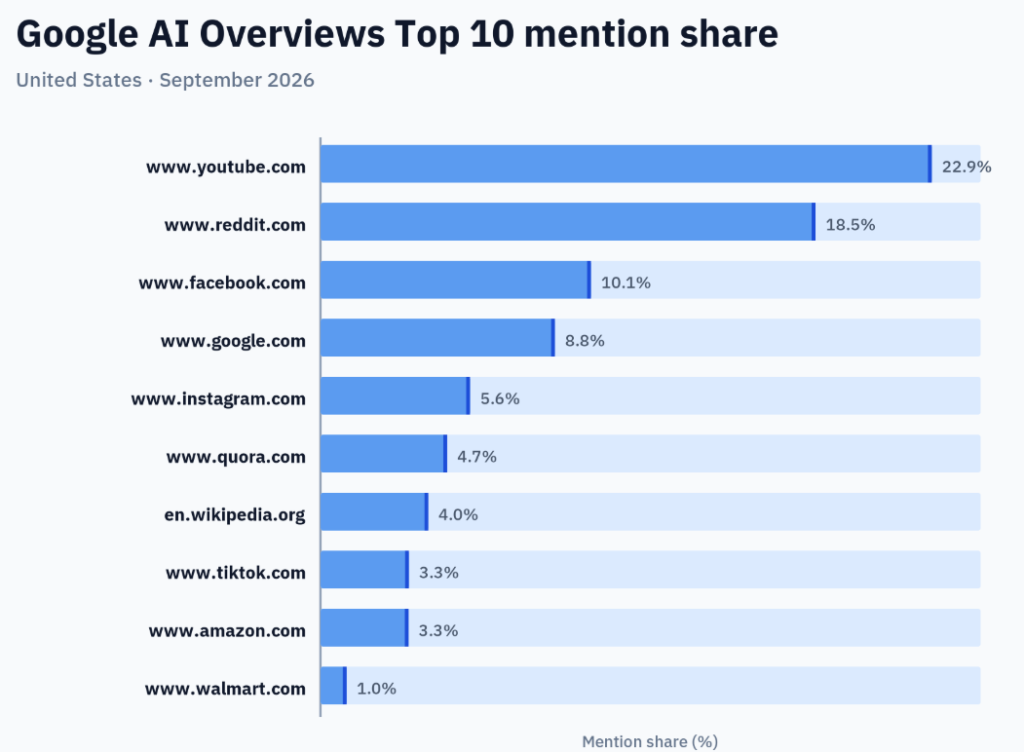
So you should use video as an SEO optimisation for your online shop. Not only does it keep users engaged and reduce purchase friction, it can also increase your visibility in AI answers.
And… for which products? Clothing (how it fits), textures, creams, demos… Amazon has been encouraging user video reviews for years.
And don’t forget Google Lens: more and more people take a photo (or pass it to ChatGPT) and ask “where can I buy this?”. Having real, well-optimised images in your online shop is what makes that product the one that shows up.
Your ecommerce structure
You need to structure your shop properly for a better browsing experience for users (they reach your products in just a few clicks) and a better understanding for Google, which grasps what your site is about and indexes it more easily. The most common approach is a SILO structure, where content is organised hierarchically into categories and subcategories down to the products:
Home – Categories – Subcategories – Products.
Two basic rules that are usually not followed:
- A maximum of three clicks from the home page to any important product or category. The deeper a product sits, the harder it is for users and bots to reach it.
- Granularity: Create enough categories and subcategories so that each has a reasonable number of products, rather than piling 100 into a single one.
Be careful with infinite scroll. As a usability feature it isn’t bad, but it often leaves orphan pages. No bot scrolls or clicks “load more”, so products on “page 10” don’t exist for Google or ChatGPT. That’s why some ecommerce sites “don’t sell older products”: they aren’t crawled. Only use it if your entire architecture is accessible via links; otherwise, create an indexable URL for each product.
Also avoid leaving categories as a simple product listing with no text: Google reads them as thin content (little value). Add a useful description of at least 800-1,000 words to each one.
Finally, take care of your URLs and don’t let them be generated automatically. A clean structure such as shop.com/category/subcategory/product is easier for Google and users to read (URLs full of numbers create distrust).
An example could be: Home – Categories – Subcategories – Products
Headings
H2, H3… headings are important for organising content logically and making text easy to read.
In addition, using headings correctly also benefits your ecommerce SEO, as it helps search engines better understand the structure of your content.
A page’s H1 should include the main keyword, while the other h2 and h3 headings are used to organise the content. You can also include related keywords.
SEO title and meta description
Together they form the snippet, which is the excerpt users see in the search results.
- The meta description should grab attention by clearly describing what users will find. You can include hooks such as “free delivery” or “offers on orders over X euros”. This improves CTR (click-through rate).
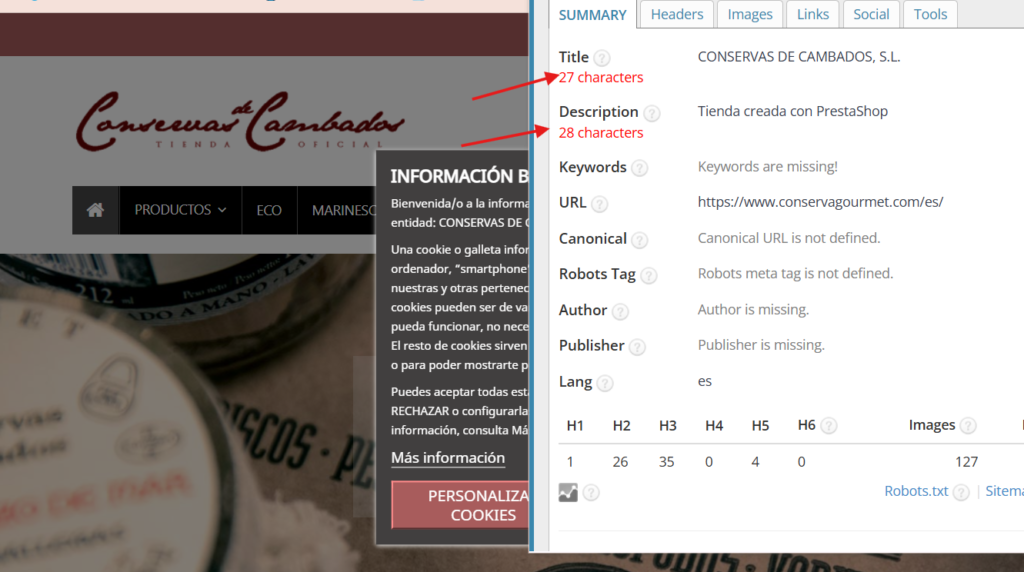
- The SEO title is what appears in the search results. It should be eye-catching and include the main keyword, so much so that users, just by reading the title, know what they will find at that URL. Don’t obsess over the exact length (Google rewrites a huge number of ecommerce titles, especially on mobile); focus instead on making it clear and setting your page apart from similar ones.
Do everything you can to avoid what happens in the image below. Both the SEO title and the meta description are very important for SEO and GEO, and for both Google and AI to find you.
Interlinking for ecommerce
Internal linking is very important for ecommerce sites because it improves user navigation and makes indexing easier. And it’s the foundation for good link building: if you gain authority through external links but haven’t worked on your internal linking, that link juice won’t be distributed across your categories and products, and your efforts will have been in vain.
Some things you can do:
- Display categories on the home page (your shop window) so that they receive authority and pass it on to the products.
- Link related categories to each other (from “running shoes” to “running socks”).
- And from the blog, steer users towards transactional pages. Use varied, natural anchor text (Google is increasingly semantic), without always repeating the same exact-match keyword.
Structured data (Schema)
It helps Google (and LLMs) understand without any margin for error what each page is, what product you sell, at what price, with what stock and with what ratings.
The schemas most relevant to an ecommerce site:
- Product (product pages): Name, image, description, price, availability, reviews and ratings.
- CollectionPage (categories): To mark up a page that groups a collection of products.
- BreadcrumbList (breadcrumbs): Reinforces the site hierarchy.
- FAQPage and VideoObject: For your FAQs and your videos.
For AI, the clearer you make the context (that your product is in stock, is sustainable or matches what the user is asking for), the easier it will be for it to recommend you. If you use WordPress/WooCommerce, plugins such as Rank Math or Yoast help you implement it without touching any code.
Product pages optimised for AI
This is one of the areas where an ecommerce site has the most at stake, and depending on the type of business, these are the elements to look after:
- Unique value and disambiguation: If you have two similar products that meet the same need, explain (as the “expert” in your sector that you are) when to choose one or the other.
- Your own description, never the supplier’s: Using the description provided by the brand creates duplicate content. Write your own, in your own words.
- Real images, video, audio: That clarify sizes, how the garment looks, macro photos. Audio (the owner explaining her product) adds a personal touch.
- Reviews, no exceptions: Enable them on your website as soon as possible; you can even choose which ones to display.
- Cross-selling and upselling that make sense: Recommendations of other products should have a logical connection. And something very important for AI visibility: you need to explain it in text, not just with bundles built in JavaScript, because ChatGPT won’t read them. For example, “if you buy this camera, we recommend this tripod” is crawlable content that can come up in a conversation with AI.
- Breadcrumbs: They show users where they are in the shop and let them go back to the category, as well as reinforcing the architecture and indexing.
- Stock management: Don’t direct SEO traffic to permanently out-of-stock products. If the shortage is temporary, offer a back-in-stock email alert so you don’t lose that sale.
- Shipping, returns and filters: Only index the filters that can attract traffic (for example, a specific colour).
Off Page SEO
Off Page SEO is the set of optimisation strategies carried out outside your website, with the aim of getting other websites and online shops to link to yours and speak well of it.
You could say that Off Page SEO and link building are synonyms. Although Off Page SEO covers more ways of getting links, link building is the most effective way to increase the authority and relevance of your ecommerce site. We can also say that GEO equals Off Page SEO, since the online reputation signals coming from third-party websites are the foundation for appearing in AI.
Link building to increase your ecommerce authority
We now come to one of the most important points of ecommerce SEO because, even with good products and good content, without links there are no rankings. To put it more bluntly: without links there are no sales. Getting quality links for your online store will increase your domain authority and, with it, your online visibility.
That said, prioritise quality over quantity: it’s better to get 10 links from leading websites related to your sector than 50 from sites that pass on neither authority nor traffic.
Getalink: link building for ecommerce
If you’re looking for the most reliable way to gain authority and sales with your online shop, Getalink is the platform you need. It’s the link building and digital PR marketplace chosen by more than 1,000 agencies and SEO experts.
It has a presence in 120+ countries and 30,000+ media outlets and niche blogs related to your business. The difference compared with other platforms is that the agreements with media outlets here are direct, with no resellers in between, which translates into verified links and better prices.
Getalink doesn’t just improve your classic SEO; it also works on your AI visibility, which is exactly what you need for ChatGPT, Gemini or Perplexity to recommend your ecommerce site.
These are some of its advantages for online shops:
- Buying links on relevant media outlets, prioritising topical relevance and editorial quality for a safe link profile.
- Copywriting included in the price: 100% original articles, optimised for both Google and generative engines (LLMs).
- Brand mentions for AI: Brand mentions in relevant contexts, to strengthen your authority and online reputation.
- E-E-A-T signals: Content signed by specialist journalists that brings credibility and trust to your brand.
- Link insertions in articles that are already published and indexed, for a more immediate impact.
- Managed service (SEO Project Manager): An expert designs and executes your strategy from start to finish (media outlets, content and anchoring).
- Marketplace with SEO metrics from Ahrefs, Moz, Majestic and SE Ranking, advanced filters and average delivery in 5 working days.
- Based in Andorra, which allows it to offer very competitive prices.
Sign up for free and start building the authority your ecommerce needs to rank on Google and in AI!
Get started nowUGC, forums and social content
User-generated content (UGC) provides social validation from a third party rather than from the brand itself. For example, brands such as Adidas feature real outfits from their customers, GoPro shows the results of its cameras and Amazon integrates video reviews and unboxings into its product pages.
Don’t forget forums and communities such as Reddit or Quora. AI draws heavily on what is said in them. If you are mentioned in those spaces as a trustworthy shop, naturally and repeatedly, it’s a powerful signal for an LLM to take you into account when someone asks “where can I buy X?”.
Promote your online shop on social media
Another way to get backlinks for ecommerce is through social media. Sharing links to your products increases the chances of users sharing them too, generating backlinks and social traffic to your ecommerce site.
Marketing activities such as giveaways generate engagement and attract potential customers; make sharing the post (with the links to your shop) an entry requirement to achieve greater reach.
Other link building strategies for ecommerce
As well as acquiring links on media outlets, there are tactics that are very specific to ecommerce link building, such as:
- Contact the suppliers of your products that publish a list of shops where they can be bought on their website, so that they include you.
- Offer to be a guest author (guest blogging) on blogs related to your sector, with a link to the relevant category or product.
- Check the websites that already mention you without linking and ask them for the link.
Technical SEO for ecommerce
Technical SEO is vitally important for ecommerce sites. These are the aspects you can’t neglect:
- Crawling and indexing: Google spends a limited amount of time crawling your website (the crawl budget). And on an ecommerce site, internal searches and filters generate thousands of redundant URLs that eat it up. Configure your robots.txt properly so that bots ignore the cart, search, sorting options and filters with no value. Create an XML sitemap with the URLs you do want indexed and use index/noindex tags to index only the pages that meet a search intent. Remember too that AI models don’t have Google’s crawling resources, so the simpler and more accessible your website is, the better.
- Duplicate content: Very common in ecommerce and penalised by Google. It appears when you use supplier descriptions, or when the same product sits in several categories or is displayed through filters with different URLs. Fix it with the canonical tag pointing to the main URL and with noindex on the versions you don’t want indexed.
- Discontinued products: Don’t simply delete a product page: you would create a 404 error that harms your rankings. Instead, set up a 301 redirect to a similar product or its category; show similar products on that same URL; or deindex it with noindex before removing it.
- Loading speed: A slow shop ruins the experience and sends abandonment soaring (would you enter your card details on a website that stutters?). Install a WPO plugin, choose good hosting and a lightweight theme, reduce plugins and optimise images. You can measure your online shop’s speed with PageSpeed Insights.
- SSL certificate: Essential for secure data transfer and for building trust when users enter their personal and banking details.
- Internationalisation (hreflang): If you sell in several languages or countries, implement the hreflang tag so that Google shows each user the right version and you avoid duplicate content issues between languages.
- Analytics: Without measuring, you can’t interpret data or fix SEO mistakes. Use Google Analytics and Search Console, as well as premium tools such as Sistrix, Semrush or Ahrefs.
It’s also a good idea to identify the URLs that generate the most sales for you (the Pareto principle: 20% of pages usually bring in 80% of the results) and focus your optimisation efforts there.
Ecommerce SEO strategies combined with Google Ads
Sometimes, depending on how competitive the sector is, it’s a good idea to complement your SEO strategy with Google advertising.
By combining the SEO strategies we’ve covered throughout this article with Google Ads, you’ll appear for the keyword in question in two ways: organically and through ads, such as Google Shopping.
In this section we’d like to share the tip we asked for from Josep Deulofeu, an ecommerce SEO expert, whom we thank for his time and kindness.
In his own words:
“A key aspect of ecommerce SEO is optimising your presence on Google Shopping.
This channel has gained relevance, especially for transactional searches, where the product “carousel” is increasingly visible in the search results.
Taking advantage of this exposure can generate a flow of organic traffic that is very valuable, as it puts your products directly in front of users who are ready to buy.
It’s not just about appearing, but about optimising your listings to stand out from the competition, especially in markets such as the United States, where Google Shopping’s visibility keeps growing, and this will carry over to the Spanish market, as we have seen on many other occasions in the evolution of Google’s results.”
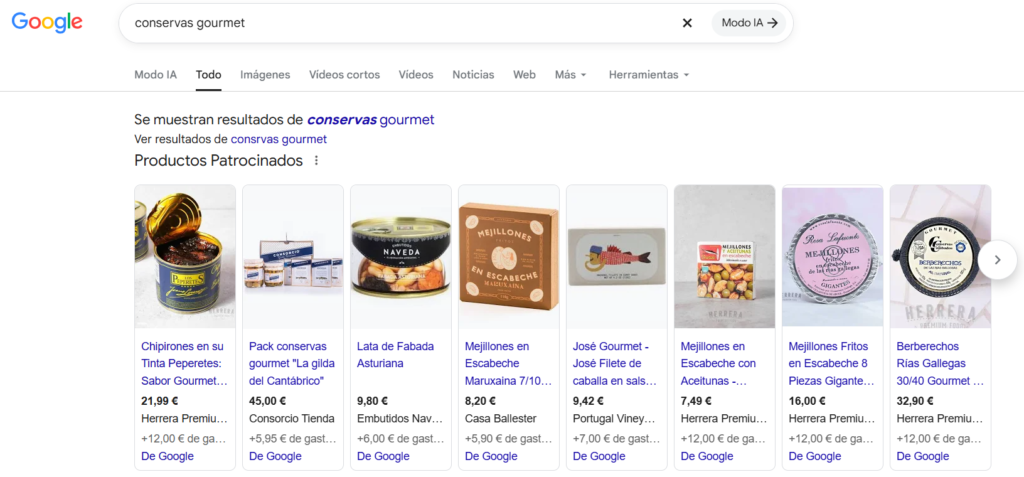
So you can apply this ecommerce SEO expert’s recommendation right away.
Another way to complement your strategy is to invest in advertising such as Social Ads; these campaigns also tend to perform well.
SEO particularities depending on your CMS
Doing SEO for an ecommerce site also depends on the content management system. None of them is “the best”: it depends on your project. Here’s a summary of what to keep an eye on in each one:
- Magento / Adobe Commerce: the most powerful for SEO (sitemap, robots.txt, redirects, canonical, basic Schema…), but it requires technical knowledge and time.
- Shopify: Easy to use and ideal for getting started, but with SEO limitations. It generates duplicate content and an excess of internal links because of its product URLs, and the sitemap and robots.txt offer little configuration.
- WooCommerce (WordPress): Very flexible. Review the default URLs (you can clean them up with Rank Math or Yoast) and strengthen the Schema markup, which is limited out of the box.
- PrestaShop: Lets you customise URLs, but watch out for poorly optimised themes and the numeric IDs it creates by default (best not to touch them so you don’t get tangled up in redirects).
Frequently asked questions (FAQ) for ecommerce
An FAQ module helps you appear in AI and works very well. But be careful: don’t turn all your content into questions and answers. We’re seeing landing pages that used to convert very well lose rankings and selling power after being rewritten entirely in this format to “please artificial intelligence”.
For complex topics (health, technical services), users need in-depth information. Use FAQs as support, not as a substitute for content, and mark them up with Schema (FAQPage).
Core updates: they’re still there
Core updates and spam updates still exist, even if they don’t get as much hype any more. The difference compared with the past is that today it’s much harder to detect a pattern. Before, a whole vertical could drop in one go; now you “bleed out” little by little, with individual URLs, and one day you notice without really knowing why. As Betlem Cardona summed it up a few days ago on Campamento Web, very often “they kill you off bit by bit and then, with the core update, they finish you off”.
A couple of practical lessons:
- Many drops start earlier: The sharp decline usually coincides with the update, but when you review the history you find that those URLs had already been falling for those keywords. Google reassesses (“your content isn’t that interesting any more”) and the core update finishes the job.
- Rule out the obvious first: Seasonality, technical changes or recent migrations. Confirm the drop with your own Search Console data (not just third-party tools) and compare with your competitors, who have often grown precisely where you are falling.
- The recovery plan involves strengthening internal linking to the affected pages, creating specific, up-to-date content for that target, and working on UGC and mentions. In many cases it isn’t a “penalty”: it’s that others did it better than you.
The future: agentic search
Where are we heading? Everything points to agentic search. You describe what you need in natural language, the AI advises you, compares options and, in many cases, can complete the transaction. It sounds like science fiction, but it’s something we’ve already experienced with insurance comparison sites or Skyscanner, where you bought a flight from an airline through a third party.
The interesting thing is that, deep down, AI is recreating the same old SERPs with a different interface: instead of a list of blue links, it gives you a reasoned list of options with a preview, price, pros and cons.
Google, in a way, has become its own “comparison niche site”, and transactional search will also evolve in that direction. For your ecommerce, this reinforces everything above: structured information, product pages that explain who each product is for, reviews, video and a brand that people speak well of.
And that wraps up our guide to SEO=GEO for ecommerce. We hope you’ve found it useful.
Optimising ecommerce SEO is key to increasing your online business’s traffic. Optimise your content and invest in link building to improve your visibility in AI.
Request a quote for your backlink strategy
Shall we talk about your project?
Tell us what you need (full name, email, website, message) and we'll get back to you within 24 hours.
Send