

For years, link building was seen as a race to earn more quality backlinks than your competitors. However, the arrival of Google AI Overviews, ChatGPT, Perplexity and the upcoming Agentic Search systems has changed the rules of the game.
Today, visibility no longer depends solely on ranking at the top of Google, but on being a trustworthy source that AI models choose to cite, recommend or use to build their answers.
The debate is no longer about whether links still matter, but about what kind of authority generative engines recognise and how we can build that visibility in AI.
In this new landscape, links are still relevant, but they have evolved from simple ranking signals into indicators of credibility, topical authority and brand recognition. Other factors are also gaining prominence, such as unlinked mentions, co-citations and digital PR (digital public relations).
Read on to discover the recent studies confirming that domains with greater authority and more external mentions appear more often in AI answers.
Studies on the importance of link building for GEO
Link building for GEO means earning links and mentions on third-party websites so that artificial intelligence models recognise your brand as a reliable source and cite you in their answers.
It is no longer just about ranking on Google, but about showing up when someone asks AI.
That said, if your SEO is done well, it is already benefiting you in LLM answers.
The importance of brand mentions
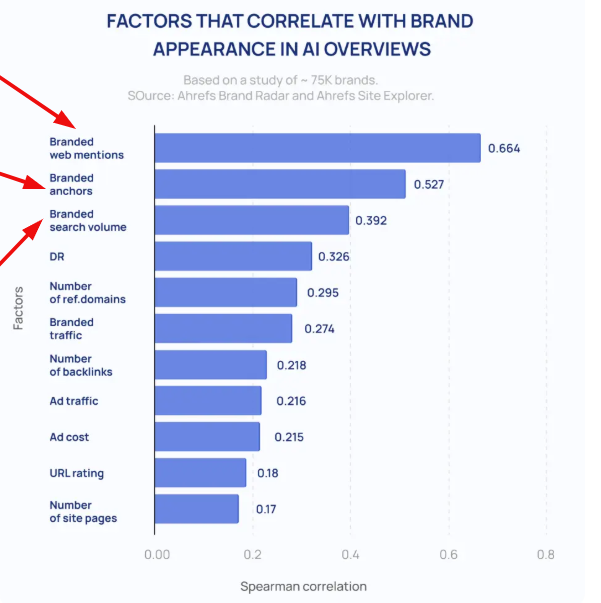
Brand mentions correlate three times more strongly than backlinks with visibility in AI answers. In a case study, “Ahrefs” analysed 75,000 brands to see which signals best predict whether you appear in Google’s AI Overviews.
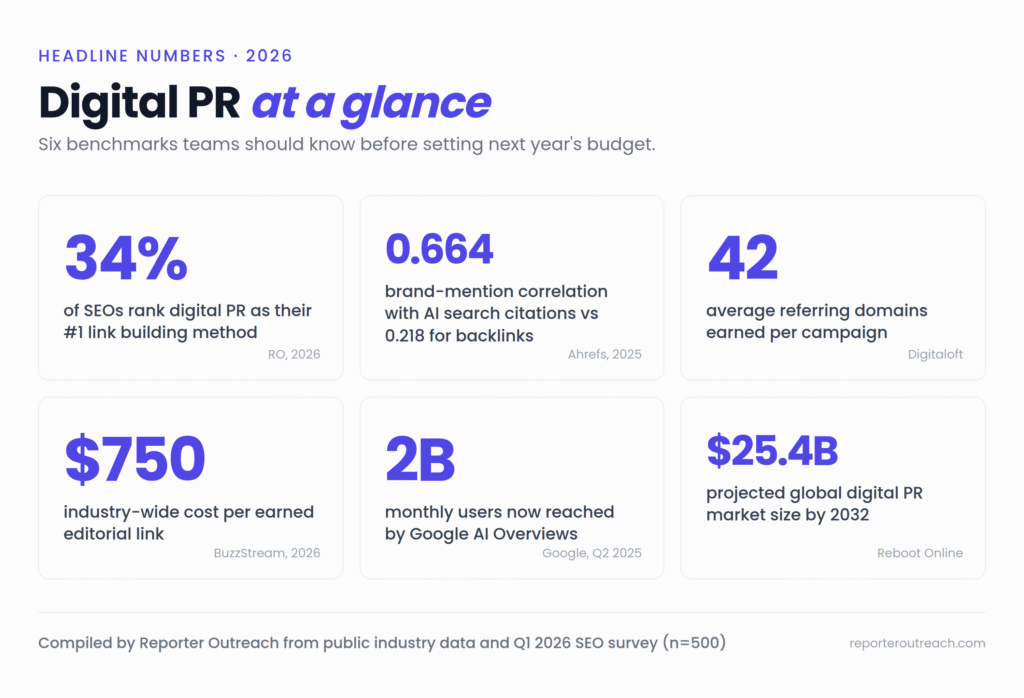
The result? Brand mentions across the web showed a correlation of 0.664, compared with 0.218 for traditional backlinks. That is a 3-to-1 advantage in favour of mentions.
What is more, something very interesting for anyone working with video content is that YouTube mentions are the single strongest signal of all (a correlation of around 0.737).
Does this mean backlinks no longer work? Not at all, and we will see why shortly. But it does tell us something very important in the AI era: off-page SEO is no longer just “building links”, it is building a brand that others talk about.
| Off-page signal | Impact on Google rankings, SEO | Impact on AI citation, GEO |
| Editorial backlink | High | High |
| Brand mention | Moderate | Very high |
| Content with original information | High | Very high |
ChatGPT 5.5 confirms that brand co-citations are one of the most important AI visibility factors
Another study by Seer Interactive (June 2026) has revealed a significant change in how ChatGPT 5.5 generates its answers. When the AI receives a question, it fires off sub-queries (fan-out queries) to research before answering. What has changed is the type of sub-queries it generates.
Previously, ChatGPT searched for generic queries such as “best SEO agency” or “top GEO tools”. Now, fan-out queries include specific brand names, such as “Getalink Link Building study”, or searches restricted to specific domains, such as “site:seerinteractive.com AI search visibility”.
This has a huge implication: if your brand is not part of the fan-out queries, you are locked out of the answer. It does not matter how many listicles you publish. If the AI searches for “Getalink GEO strategy”, only Getalink’s content can answer that query.
“Top 10” style listicles are losing relevance compared with brands the AI already associates with the topic.
How does a brand become a “default brand” for AI?
Not with low-quality scalable tactics, but through original research, mentions in leading media, appearances at conferences and in industry publications, and content that people genuinely share and reference.
This study reinforces the importance of link building and digital PR as a strategy for GEO. Brand mentions in quality media, co-citations alongside industry leaders and consistent editorial presence are exactly the signals that turn a brand into AI’s default answer. It is no longer about being on a list. It is about being the brand the AI searches for by name.
Is your brand embedded in the minds of LLMs? At Getalink we can help you:
Get started now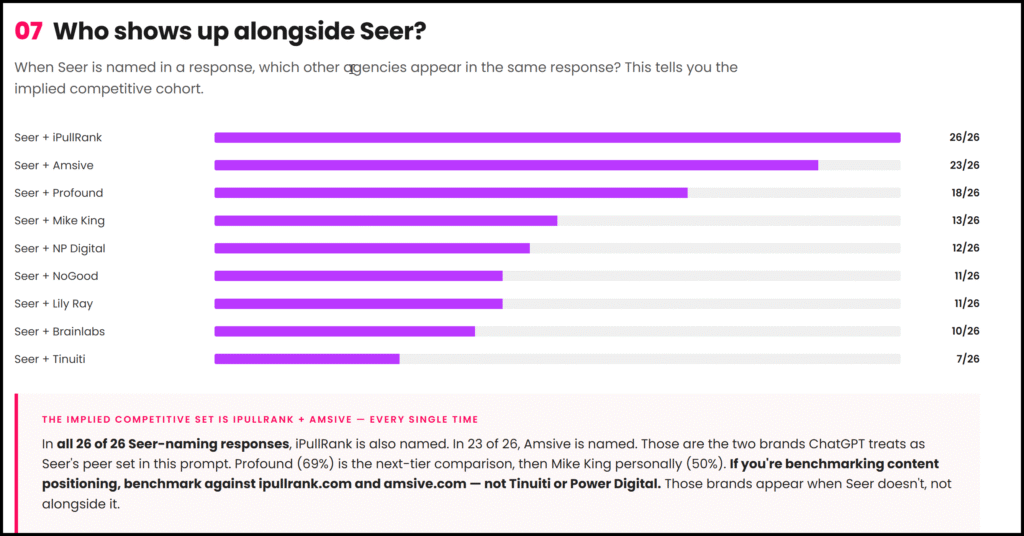
This Seer Interactive chart shows a real example of brand co-citation in ChatGPT answers. Out of 26 answers in which the AI mentioned Seer Interactive, iPullRank appeared alongside it in 100% of cases and Amsive in 88%. The AI has decided that these three brands form a reference group in the GEO sector.
This shows how LLMs build “implicit competitor groups” based on the brands that are consistently mentioned together in external sources. If your brand is co-cited with the leaders in your sector, the AI will include you in that same group when it receives related queries.
What kind of sources does AI cite?
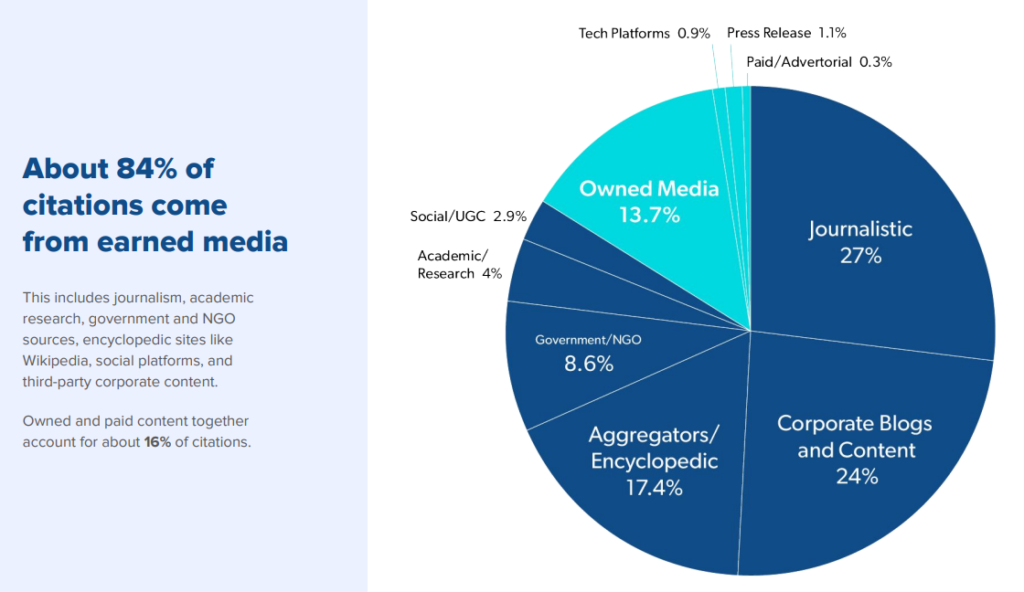
According to the “Muck Rack” study, 99% of the links cited by AI come from non-paid media. The breakdown by source type makes it clear where AI focuses its attention:
- Journalistic content (27%): Press articles and news media. The number one source AI considers reliable for building its answers.
- Corporate blogs and branded content (24%): Content published on company blogs with real authorship (not the usual “admin”) and verifiable data.
- Aggregators and encyclopaedic sources (17.4%): Wikipedia-style platforms, reference directories and content aggregators.
- Owned media (13.7%): Corporate websites and brands’ own editorial resources.
- Government and NGOs (8.6%): Institutional sources that AI models consider highly reliable.
- Academic and research (4%): Studies and content from universities or research centres.
- Social and user-generated content (2.9%): Reddit, forums and social platforms.
The upshot is that AI prioritises editorial, journalistic and original content sources above all others.
Backlinks matter more than ever
Fine, mentions carry a lot of weight and the data proves it. But let us look at the studies and analyses on backlinks, because the figures are still overwhelming. “LinkPanda” analysed more than 3,000 backlinks from 800 brands and these are the results:
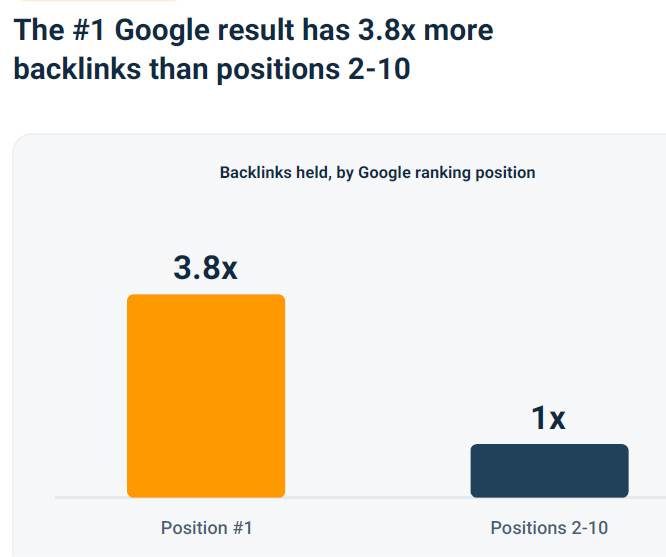
- Google’s #1 result has 3.8 times more backlinks than positions 2 to 10 (across 11.8 million results).
- 66.31% of all web pages do not have a single backlink (more than 1 billion pages). Those that do earn links take almost all the visibility.
- Long-form content (over 3,000 words) earns 77.2% more links than short content.
The conclusion is that links still correlate with better rankings. And as we have already seen, ranking well on Google increases your chances of being cited by AI. So it is a circular strategy you should put into practice on your website.
In fact, 73.2% of link building professionals believe backlinks influence visibility within AI-powered search results, and 80.9% think unlinked mentions also affect organic rankings. That is why one feeds the other.
Digital PR, the winning strategy for GEO
If we had to pick just one link building strategy for GEO that works on both fronts (links and mentions), it would be Digital PR. And it is not just us saying so, the statistics say it too:
The “Reporter Outreach” study reveals that 34% of SEO professionals choose Digital PR as their most effective technique.
A PR campaign earns links from an average of 42 different domains with an average Domain Rating of 61, and 85.2% of professionals see measurable results in under 6 months.
Furthermore, according to BuzzStream’s “State of Digital PR 2026”, 83.1% of professionals say Digital PR has grown in importance over the last 12 months precisely because of AI. The digital PR services market is projected to reach 25.4 billion dollars by 2032.
Digital PR is the only strategy that simultaneously builds the two signals AI uses to decide whom to cite, authoritative backlinks + brand mentions, which is why it is so powerful.
Mentions in the local press
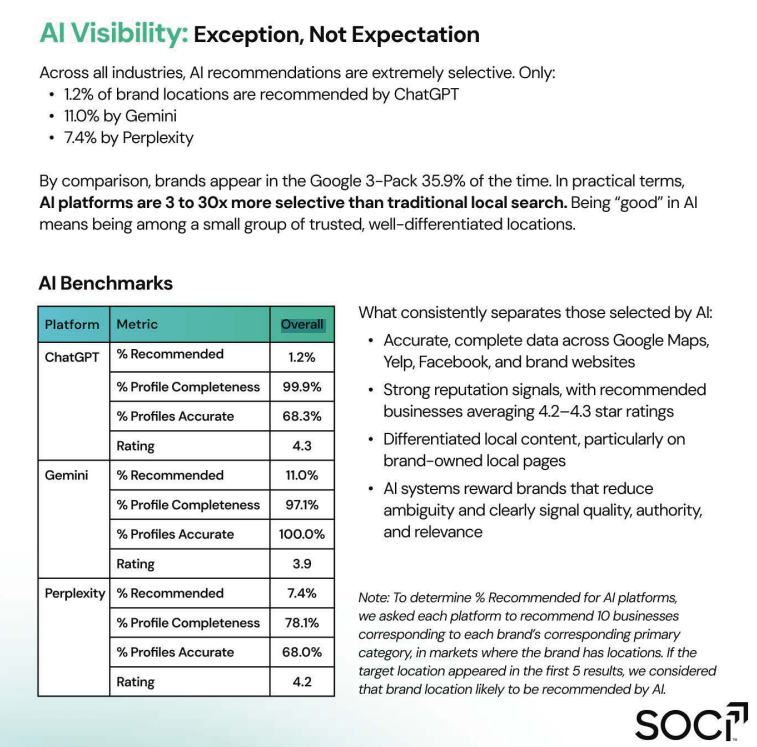
SOCi’s “Local Visibility Index 2026” analysed more than 350,000 locations and found that only 1.2% of local businesses are recommended by ChatGPT (11% by Gemini and 7.4% by Perplexity).
Compared with the 35.9% that appear in Google’s local pack, this means local visibility in AI is up to 30 times harder to achieve than traditional visibility. A business can be dominating classic local SEO and still be invisible to anyone asking AI.
On a very positive note, however, ChatGPT systematically includes Google Maps results as citations, at a rate of 188 Maps citations per 1,000 queries. So if you have a physical business, you cannot afford to neglect your listing.
On top of that, “BEST OF” or “TOP LOCAL” style lists have become a powerful new factor in 2026 for both local SEO and AI. And getting featured in those lists, in local media and newspapers, is a job for link building and press coverage.
Moreover, in local queries links have a correlation of 0.33, because when all local service websites look alike, links are the differentiating factor that tells the AI who has the most authority in the area.
Get started nowGEO, zero-click search
68% of Google searches do not generate clicks, so the question in this new situation is: “if AI does not send clicks, why should I work on GEO?”. And the answer is that the few clicks that do arrive are high quality.
Traffic coming from AI converts better than traditional organic traffic, according to the “Seer Interactive” case study:
- 15.9% from ChatGPT.
- 10.5% from Perplexity.
- And 5% from Claude.
- Compared with 1.76% from classic organic search.
The reason? Behaviour: a user arriving from ChatGPT has already done their research within the chat, compared options and decided; they arrive with their wallet in hand.
And as if that were not enough, brands cited in Google’s AI Overviews receive 35% more clicks on their organic result alongside. In other words, being in AI does not cannibalise your SEO, it reinforces it.
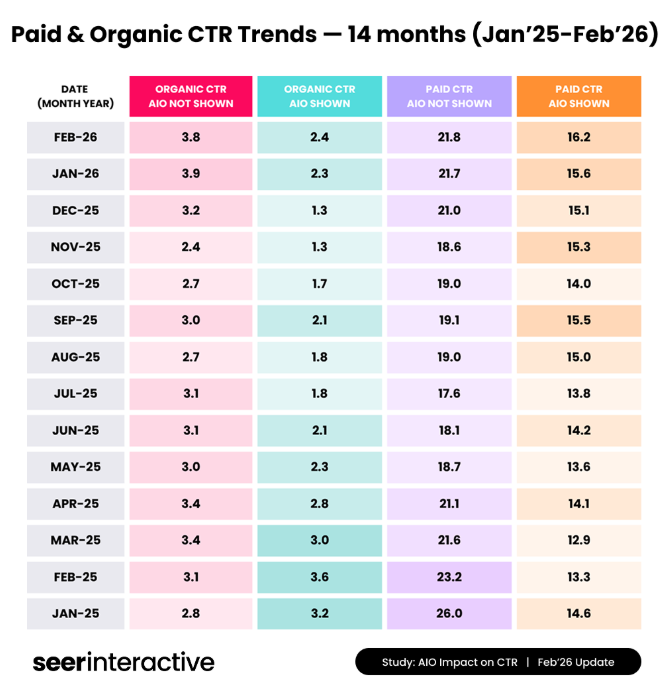
In addition, the most recent analyses (Seer Interactive, April 2026), based on 53 brands, 5.47 million queries and 2.43 billion organic impressions, confirm a positive signal: after 18 months of continuous decline, organic CTR on queries with an AI Overview has recovered by 85% in just two months, rising from 1.3% in December 2025 to 2.4% in February 2026. The drop in clicks is levelling off.
Most importantly, brands cited within AI Overviews saw their impressions double while clicks held steady, confirming that being cited by AI amplifies your organic visibility rather than cannibalising it.
What can you do to get AI to cite your website? Strategies that work
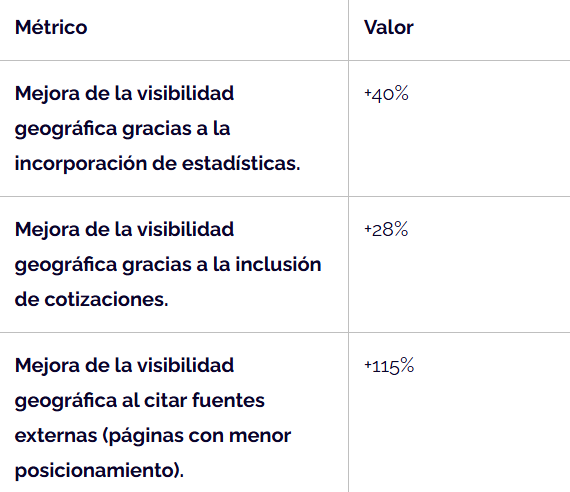
In the “Omnibound” statistics, they tested several techniques across 10,000 queries and measured which ones work:
- Adding statistics to your content improves AI visibility by 40%.
- Including quotes from experts improves it by 28%.
- Citing reliable external sources boosts it by 115%.
As for content length, adding more words on its own does nothing. What counts is the density and accuracy of the data and the credibility of the sources.
There are also other practical factors worth bearing in mind:
- Answer questions in the opening paragraphs (44.2% of LLM citations come from the first 30% of the text).
- Keep content fresh (content less than 3 months old is cited up to 3 times more).
- Use structured data with schema (it improves information extraction from 16% to 54%).
- Allow AI crawlers through your robots.txt (GPTBot, PerplexityBot, ClaudeBot). Everything else is pointless if the door is shut and AI cannot crawl your website.
AI search is a third-party citation problem with an on-page corroboration base
One of the most recent studies is by Aleyda Solis (August 2026). She analysed the 10 most cited sources for 15 leading brands across three sectors (SaaS, ecommerce and finance) on AI Mode, Gemini and ChatGPT, using Semrush Enterprise data. And her conclusion sums up everything we have seen in this article: AI visibility is, above all, a third-party citation problem, with your own website as the base that corroborates the facts.
The result? In all three sectors, your website is in the minority among the sources AI cites to build its answer. External sources account for 82.3% in SaaS, 79.4% in finance and 69.6% in ecommerce. Even in ecommerce, the sector where owned domains carry the most weight, external sources never fall below two thirds.
| Sector | Owned sources | External sources | Dominant external source type |
|---|---|---|---|
| SaaS | 17.7% | 82.3% | Social and communities (45.7%): Reddit, YouTube |
| Finance | 20.6% | 79.4% | Media, reviews and comparisons (earned 49.6%) |
| Ecommerce | 30.4% | 69.6% | Competitors and marketplaces (36.6%) |
What is interesting is that the external mix changes by sector:
- In SaaS, social and communities dominate.
- In ecommerce, marketplaces and competitors’ pages, which AI uses as commercial proof.
- And finance is where media, reviews and comparisons carry the most weight, with total earned media of 49.6%, the highest of the three verticals. In other words, pure Digital PR territory.
It also changes depending on the AI:
- AI Mode is the most “social” (in SaaS, up to 74.6% social sources).
- ChatGPT leans more on a written, evaluative layer (comparisons, reviews, publications).
- And Gemini is more mixed.
That is why each platform needs to be analysed separately.
She also highlights two nuances worth remembering:
- AI citing your website does not mean it recommends your business. Citation and recommendation are different things.
- A flawless website without external backing stays silent, and lots of external mentions without clear facts on your domain do not work either. You need both: your own facts that AI can verify + validation from outside.
In fact, her own survey confirms that 53% of professionals already invest in digital PR and social as part of their AI strategy, and only 16% work on neither. Anyone still optimising only their own website is falling behind.
If you look closely, this study once again shows that the authority that decides whether AI cites you is built outside your website, in media, reviews, comparisons and communities. Exactly the work on links, brand mentions and digital PR that we do at Getalink.
Get started nowLink building and digital PR are the foundation of GEO
GEO has not killed link building, it has made it more important than ever. What has changed is the approach: it is no longer about piling up links for the sake of it, but about building real authority and getting others to talk about your brand on trusted sites that are relevant to your topic.
Here is a simple action plan to get started:
- Audit your link profile and your brand mentions.
- Identify your best assets for attracting links: an in-house study with original data, a survey.
- Launch a digital PR campaign with that original data to earn mentions and links in authoritative media in your sector.
- Reclaim the mentions you already have that do not include a link.
- Work on the local press by earning local citations, if you have a physical business.
An AI-powered GEO platform for link building like Getalink is the solution, as it combines link building and brand mentions with a single goal: increasing the likelihood that generative engines identify, trust and cite your brand when answering users’ queries. With our marketplace you get access to more than 20,000 media outlets (newspapers and blogs). An expert-managed digital PR service, brand mentions, local citations… all to improve your AI visibility.
AI will keep evolving and nobody has a crystal ball, but one thing is certain: the brands people talk about, the ones with quality links and a good reputation, are the ones that will be cited when someone asks AI.
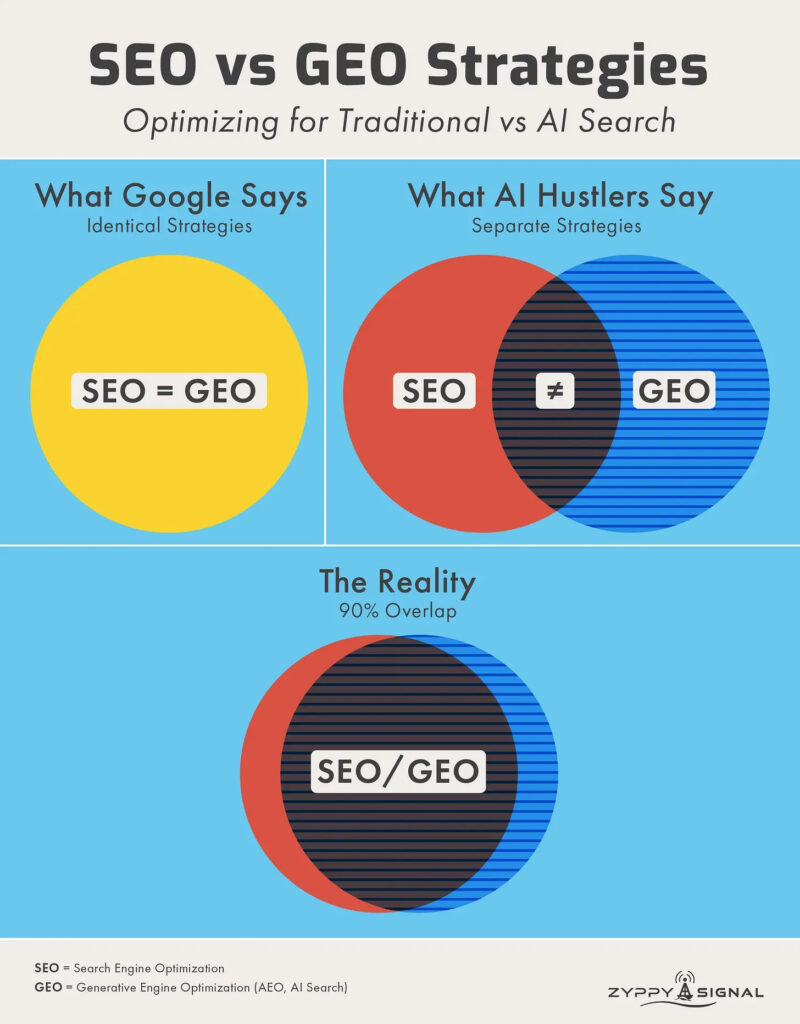
90% of AI visibility comes from well-executed SEO
Google claims that “good SEO is good GEO”. Is that really the case? A recent analysis by Cyrus Shepard (Zyppy Signal) reviewed 54 experiments and studies on AI citations and concluded that businesses can achieve most of their AI visibility goals by adapting established SEO practices, rather than creating an entirely new strategy.
In other words, you do not need to reinvent the wheel. You need to execute classic SEO well and complement it with real authority built through mentions and backlinks.
The study identified the 5 factors that matter most for AI to cite your content:
- URL accessibility (9.5/10): The number one factor. Many sites block AI bots (GPTBot, PerplexityBot, ClaudeBot) without realising it, through firewalls, Cloudflare settings or misconfigured robots.txt files. If AI cannot crawl you, it cannot cite you.
- Google ranking (9.4/10): Ranking well on Google is still the foundation. AI models use organic rankings as a trust signal. Content in the top positions is far more likely to be cited.
- Fan-out rank (9.3/10): AI models do not run a single search. They fire off multiple sub-queries (fan-out queries) before building their answer. If your content answers those sub-queries, your chances of being included increase.
- Preview controls (9.2/10): How your content is presented when AI extracts it. Structure, headings and clarity of text influence whether AI can extract a useful answer from your page.
- Query-answer match (9.2/10): Answering the user’s question directly and precisely, ideally in the opening paragraphs, significantly increases your chances of being cited.
And the factor that carries the least weight of all those analysed? The llms.txt file, with a score of just 2 out of 10.
This experiment reinforces what we have seen throughout this article: link building and digital PR, which build the real authority that both Google and AI need to trust your brand, remain the most powerful levers for gaining visibility in both channels. Solid technical SEO is the foundation, and off-page authority is what sets you apart.
Request a quote for your backlink strategy
Shall we talk about your project?
Tell us what you need (full name, email, website, message) and we'll get back to you within 24 hours.
SendSources:
- Getalink, Link Building and AI study
- Muck Rack (What Is AI Reading?, May 2026
- Seer Interactive
- Reporter Outreach June 2026
- State of Digital PR Report (2026)
- AI for Local SEO SOCI
- Omnibound 2026
- Seer Interactive June 2026
- Aleyda Solís, AI search study August 2026
- These SEO Strategies Drive 90% of Your AI Visibility