

The algorithms of Google and other modern search engines powered by artificial intelligence and large language models (LLMs) have transformed the way the authority and online reputation of our websites are interpreted. 60% of Google searches no longer generate clicks, because users get direct answers that mention companies and brands within the result itself.
In this context, brand mentions are one of the most important signals of relevance and trust for generative answers to cite us, as they act as endorsements.
If you don't adapt your digital strategy to this new reality, you will be missing out on business opportunities, because your competitors are already doing it.
By reading this article you will learn what brand mentions are and why they are so important within a digital strategy, now in the age of AI.
What are brand mentions?
Brand mentions are the references made to a company on the internet, whether in articles, social media, forums or reviews. They serve as indicators of visibility, presence and online reputation, and provide valuable information about how your audience perceives you.
There are different types:
- Direct: They use the exact name of the brand (for example, Coca-Cola).
- Indirect: When the brand is alluded to through a slogan, a feature or a product. For example, "Open happiness".
- Depending on their tone, they can be positive, neutral or negative, and can strengthen, maintain or damage your business's brand reputation.
Even when mentions don't include links, their impact is significant, as they reinforce brand recognition and can attract future customers or visits to the website.
However, there are also so-called linked mentions, which do include a link to your site. For example, a sponsored article.
What is the difference between mentions and links?
Ideally, you should combine both strategies to improve your presence, online credibility and brand reputation.
- Backlinks are links pointing to your website from other pages. They allow users to reach your site directly and pass on authority or "link juice", one of the SEO ranking factors that Google and AI Overviews, among other AI models, take into account.
- Brand mentions, on the other hand, don't include a link, but they are still valuable, as they tell Google that your brand is recognised and relevant within its sector.
The importance of brand mentions in AI answers
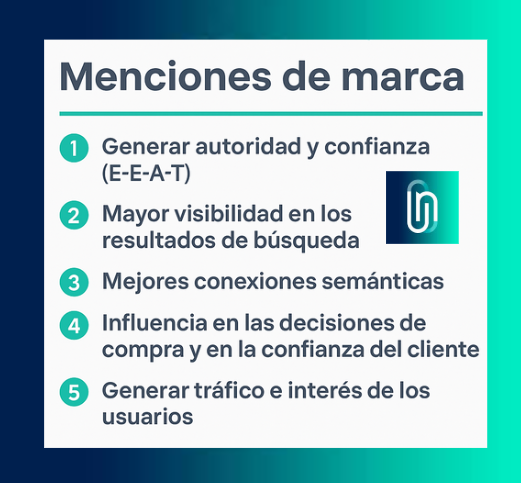
These are the benefits brand mentions bring in getting your business cited in generative answers:
They boost authority and trust (EEAT)
Mentions in relevant media and prestigious sources work as a form of recommendation.
When experts, influential blogs or industry portals talk about your company, Google interprets these references as a signal of authority and reliability. In other words, the more your brand is talked about positively in credible contexts, the more trust it will generate, both among users and in the generative answers of any AI model.
These mentions reinforce the EEAT factor (Experience, Expertise, Authoritativeness and Trustworthiness), which is so important for LLMs to cite you in their generative answers.
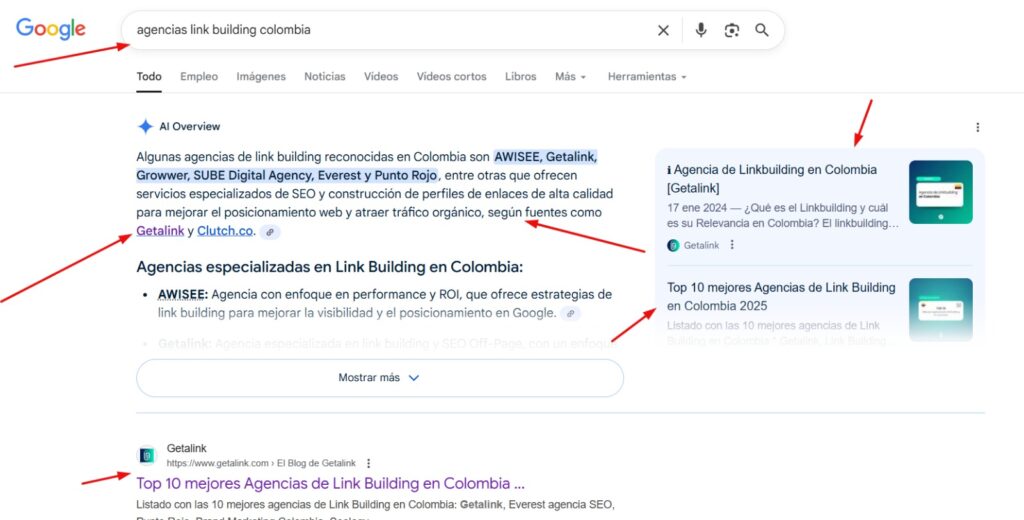
They increase your site's visibility in generative answers
Every time your brand is cited on a relevant website in your sector, a new connection point is created between your company and today's search algorithms. And Google concludes that if a relevant outlet mentions your brand, it's because your brand is also "trustworthy".
For example, if a marketing agency is frequently mentioned alongside expressions such as "SEO strategies", "successful digital campaigns" or "content SEO", it will start to be recognised as a benchmark in its sector, appearing more frequently in generative answers related to these topics.
They increase organic traffic and SEO = GEO
Brand mentions are an indirect channel of organic traffic, because when potential customers see your brand mentioned or referenced on a trustworthy website, they will usually visit your website.
This visit or branded search tends to have a strong intent to engage with your content, hire your services or buy your products.
This sends positive signals to Google about your relevance and popularity, strengthening your business's SEO = GEO and making it more likely that you will be cited in its generative answers when someone carries out related searches.
It is worth pointing out that SEO in the age of AI, that is, today, goes by the term "GEO – Generative Engine Optimization". It refers to optimising content as trustworthy in order to appear in search engines powered by generative artificial intelligence, such as Google SGE, Perplexity and ChatGPT, among the new ones appearing every day.
They strengthen semantic connections
Brand mentions also help Google better understand what your brand is about. The search engine doesn't just analyse your company name, but also the context around it, such as the keywords in the content where it appears.
In this way, stronger semantic links are established between your brand and a set of concepts or sectors. The result is that your website gains topical relevance, making it easier to appear in searches related to your topic.
They influence customer trust in your business
The impact of mentions influences how customers perceive your business. For example, when they come across positive reviews or external articles about your brand, their trust increases, as do the chances that they will choose you.
Seeing that others recommend your brand validates its quality, and users are more likely to make a purchase or hire your services.
Brand mentions as a signal of authority
The importance of brand mentions is nothing new: back in 2016, Duane Forrester, then Senior Product Manager at Bing, pointed out that even unlinked mentions could serve as signals of authority.
Later, Gary Illyes, Analyst at Google, reaffirmed that frequently cited content, whether through links, social media mentions or online references, indicates that a company is building trust and value.
So we can conclude that both Bing and Google already recognised that the simple fact that others talk about your brand is a positive signal of authority.
Studies backing the growing importance of brand mentions in the age of AI
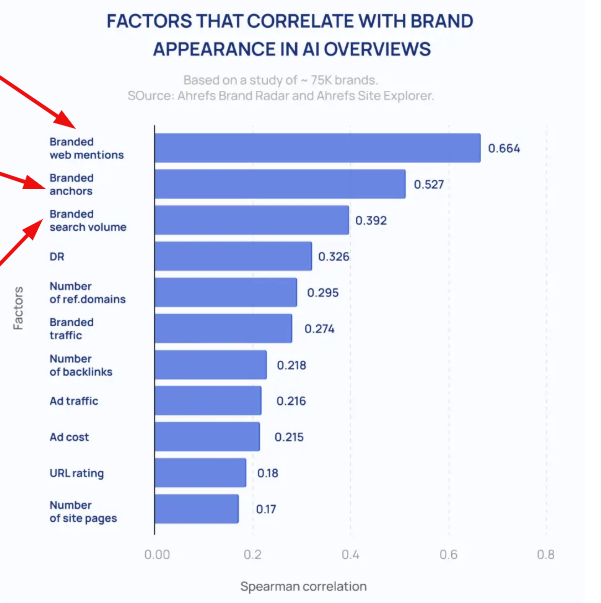
In recent years, with the arrival of artificial intelligence in search, the importance of brand mentions has grown exponentially, because as well as valuing the links pointing to your website, algorithms also take into account who mentions your brand and in what context.
Several recent studies (2025) support the growing importance of brand mentions in SEO and marketing in the age of AI:
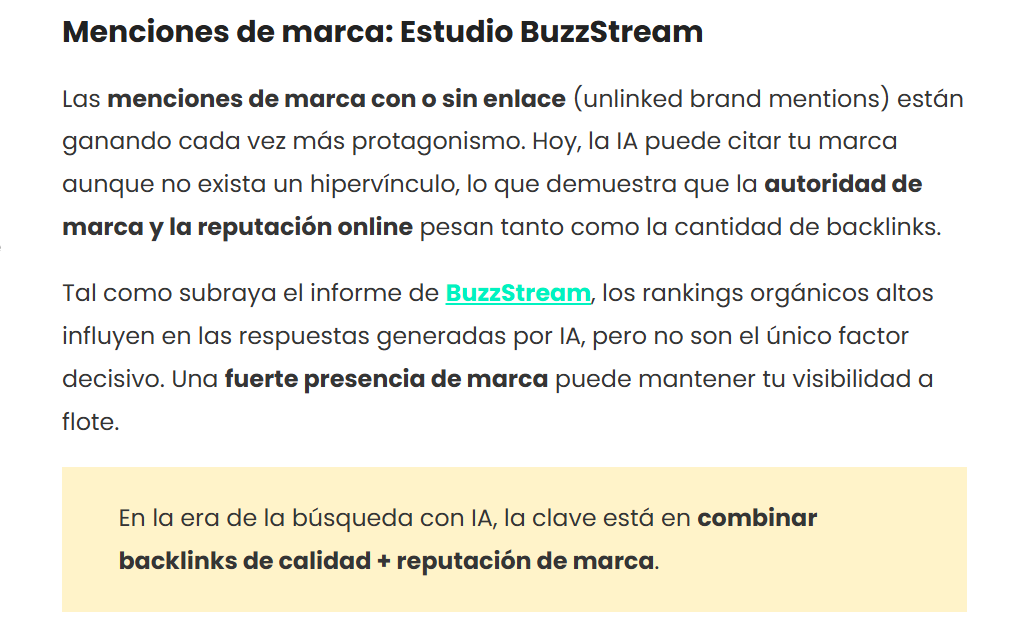
- BuzzStream study: It reveals that in the era of AI search, the key lies in combining quality backlinks + brand reputation (brand mentions).
- Seer Interactive: What Drives Brand Mentions in AI Answers? (2025). This study reveals that brands appearing on the first page of Google show a high correlation with mentions on AI platforms.
- Ahrefs: An analysis of 75,000 brands showed that the companies with the highest number of mentions appear up to 10 times more often in AI-generated results and summaries than less-mentioned brands.
- HubSpot: More than 70% of consumers trust brand mentions (that is, recommendations from other users, reviews or organic conversations) more than traditional advertising. In other words, for the public, "digital word of mouth" generates more credibility than paid ads.
- Rise at Seven: Around 60% of the factors that influence organic rankings are linked to off-page signals. In other words, a huge proportion of the content that appears in Google results comes from external sources such as social media, news or reviews (brand mentions).
- Google 2025 update (source: GetStuffDigital): Google's June 2025 core update marked a turning point by introducing brand citations directly into generative search results. For the first time, source names began to appear within Google's AI answers.
This means that simply being mentioned by AI is equivalent to holding a new "position #1" on the results page, even without a clickable link to your site. This change highlights the value of brand authority in a zero-click environment, where visibility is achieved by being the trustworthy source that the AI assistant chooses to cite.
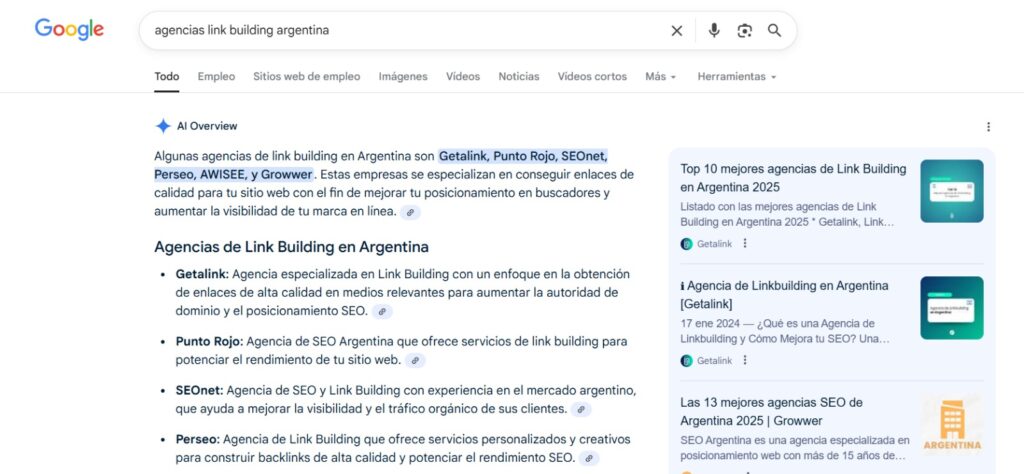
How to get brand mentions
We have already seen the importance of brand mentions for your business's online reputation, so now let's look at how to get your brand mentioned both by AI and by other third-party sites. These are some of the strategies that work:
Publish content worth citing
External mentions are one of the most influential factors for AI to recognise a brand. LLMs continuously analyse high-authority sites (media, blogs, rankings, forums) and repeat the trust patterns they find.
Taking part in listings, reviews, case studies and collaborations with recognised portals increases your chances of being mentioned by AI.
Before collaborating, assess each site with tools such as Ahrefs Site Explorer to check its authority and how often it is mentioned in AI environments.
Create useful resources that deserve to be mentioned, such as studies, reports and practical guides.
When your content is useful and solves real problems, users and generative answers will have reasons to cite you and mention you as a reference source.

Increase your presence on Wikipedia, Reddit and other forums
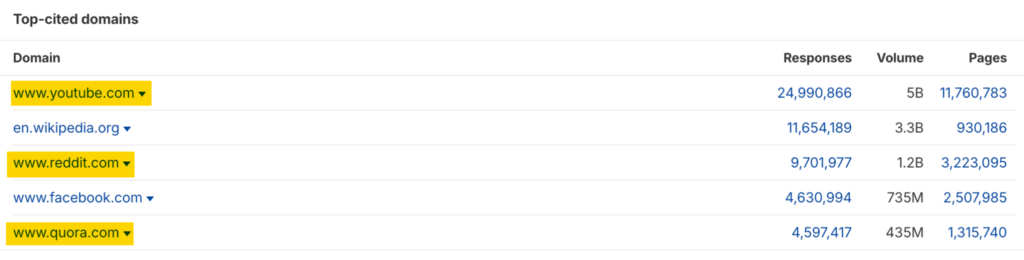
Brand mentions on platforms such as Wikipedia, Reddit, Quora, YouTube, etc. carry great weight when it comes to building digital authority. Platforms based on user-generated content (UGC) like these are the ones most cited by AI models.
These spaces have high credibility and visibility, so when a brand is mentioned naturally on them, language models (LLMs) can recognise it as a trustworthy and relevant source within its topic.
Being cited in communities and sites with a good reputation helps your brand to be "learnt" by AI systems, increasing its chances of featuring in their generative answers.
This image from Ahrefs' Brand Radar shows the domains most crawled and cited by AI.
Digital PR to earn brand mentions
Digital PR is one of the most effective tactics for earning brand mentions; for example, you can publish press releases or collaborate with specialist media.
This will increase your chances of being mentioned in news and AI-generated summaries, which will reinforce your online authority.
Get mentioned on other sites
Take an active part in forums, communities, review platforms or professional networks and provide useful answers or expert comments to increase the chances of others mentioning you as a source or trustworthy reference.
Respond to your brand mentions
Use tools such as Google Alerts, Brand24, Mention or Semrush to track every time someone talks about your brand. And respond promptly, thanking them for the mention.
Keep your brand consistent
Consistency makes it easier for both users and Google's new algorithms to recognise your brand as a solid, trustworthy entity with its own identity. So you should always use the same message and values across all channels.
Buy brand mentions with Getalink
At Getalink we offer mentions or citations in authoritative media. Once you enter the Marketplace and select a media outlet, the option to buy a citation will appear next to the price.
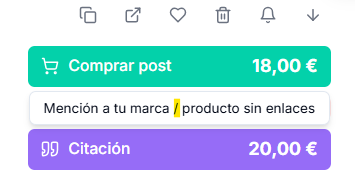
These mentions are highly valuable, as the generative answers of AI Overviews and other LLMs consider them signals of trust.
Another way to improve your brand reputation is through sponsored articles on relevant websites in your niche and authoritative sites, such as blogs, magazines and specialist newspapers, which will increase your brand's credibility and authority.
For this, trust Getalink!
Request a quote for your backlink strategy
Shall we talk about your project?
Tell us what you need (full name, email, website, message) and we'll get back to you within 24 hours.
SendExamples of brand mention strategies
Big brands use this organic mention strategy creatively. Some examples are:
Starbucks
In its #WhiteCupContest campaign, the coffee brand launched a competition inviting customers to draw on their white Starbucks cups and share the photos on social media with the hashtag #WhiteCupContest.
The result was not only free publicity, but also an avalanche of user-generated content, with thousands of mentions that increased the brand's engagement and online reputation.
As fun facts about the contest, 4,000 photos were taken in three weeks, generating more than 40,000 mentions on social media. The initiative drove a 20% increase in sales of reusable cups.
Tesla
Tesla is an example of how to do marketing without advertising: it doesn't invest in ads but relies on its fans and on word of mouth (buzz marketing) as a brand awareness strategy, as well as on Elon Musk's persona and the media attention he attracts. This generates organic brand mentions that keep the brand in the spotlight.
The company has managed to build a highly recognised global brand solely through mentions in the press, on social media and in recommendations from satisfied users. It should be noted that Tesla now reflects a loss of trust due to the controversies surrounding Musk.
Digital PR strategies
Other brands, especially start-ups and growing companies, use digital public relations strategies to obtain mentions in influential media.
For example, when a brand appears in an article about "the best products of 2025" in a relevant outlet in that sector, it is obtaining a valuable brand mention. These appearances don't always come with a link, but they still provide authority and Google recognises these signals as brand authority.
Frequently asked questions about brand mentions
Why are brand mentions important for SEO?
Because they reinforce a brand's authority, reputation and trust. Search engines and AI models consider mentions as signals of relevance and credibility.
How can I get more brand mentions?
Publish valuable content, collaborate with media and creators, take part in online communities and use digital public relations to increase visibility.
Use online reputation platforms such as Getalink.
Do unlinked mentions also help rankings?
Yes. Even without a link, mentions add value, as algorithms and large language models (LLMs) can identify the context and associate your brand with relevant topics.