

In the digital world, recommendations for your business or brand are essential, just as they are in the physical one. When someone in your industry speaks well of you, it opens doors to future customers. Well, that is more or less what backlinks are.
We could say they are like recommendations from other websites in your industry pointing to yours, which is why earning them is so important.
In this guide we explain what backlinks are and why they are essential for SEO.
What are backlinks?
Backlinks are inbound links that go from one website to another. A simple example to make it clear: when a newspaper publishes an article about your company or brand and, at the end of it, adds a URL with a direct link to your page, that link is a backlink.
Each backlink acts as a “vote of confidence” from one site to another. For example, if site A links to site B, it is signalling that B's content is relevant or of high quality, provided that site A is also a quality site.
Search engines such as Google take these links very much into account when determining the authority and relevance of a page.
You may also be interested in: The power of relevant backlinks and how to get them
The importance of backlinks for SEO
Google interprets backlinks as recommendations, so the more quality pages that recommend (link to) yours, the more trust the search engine will place in your content.
That is the main reason, but there are a few more reasons why backlinks matter for SEO:
They improve rankings
Backlinks are still one of Google's most important ranking signals (ranking factors). Every inbound link is equivalent to a vote of popularity (authority), so pages with lots of quality backlinks tend to rank higher in search results.
The studies on this subject have always shown a strong correlation between having numerous backlinks from trustworthy sites and holding higher positions on Google.

They increase your site's authority and credibility
Earning links from trusted, high-authority sites passes part of that authority on to your page (“link juice”), increasing the perceived reliability of your website. For example, if a well-known organisation (a high-authority website) links to your content, that backlink works as an endorsement of credibility.
Google has internal metrics (and external SEO tools have metrics such as Domain Authority, Authority Score or URL Rating) to measure the quality of the domains linking to you, and it rewards a link profile that comes from recognised sources in your industry.
In other words, backlinks from trustworthy sources strengthen your page's reputation in the eyes of Google and in the eyes of users.
They help new pages get indexed
Search bots use links to discover new content on the web. If your site is linked from popular or high-traffic pages, Google will be able to find and crawl your backlinks more quickly by following those links from the content that links to you.
A good link profile acts as a network of roads that makes it easier for search engines to reach more pages on your site. In addition, a solid internal linking strategy within your own website boosts this effect: when Google reaches your site through an external backlink, it can keep navigating through your internal links to index more content.
They generate referral traffic
Backlinks do not only benefit SEO, they can also attract direct visitors from other websites. If you are linked in a widely read article or a useful resource, curious users are likely to click and visit your page. This referral traffic has several advantages: it raises your brand awareness, introduces you to new audiences interested in your topic and can generate quality leads.
Get started nowWhat makes a backlink a quality backlink?
As we have mentioned, not all backlinks are equal, nor do they provide the same value. So what makes a backlink “good” for your link building strategy? The main characteristics of a quality backlink are:
- Authority: A link from a recognised and trustworthy site carries much more weight than several from low-authority websites with a dubious link profile.
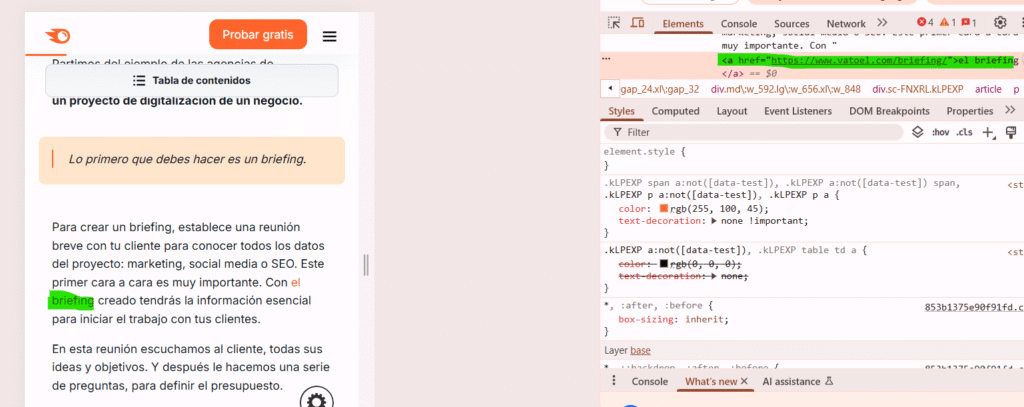
- Relevance and context: A link is worth more if it comes from a website on the same topic and is placed within the content, rather than in barely visible areas or out of context.
- Rising or stable traffic: A quality backlink is one that comes from sites that have not suffered a sharp drop in traffic.
- Anchor text: Preferably descriptive and related, to avoid over-optimising with exact-match anchor text (the same keyword).
- Link placement: Links within the main content and placed at the top of the page (above the fold) are worth more than those in the footer or in comments.
- Domain diversity: It is better to get links from many different domains than lots of links from a single one.
- Indexing: Make sure the page containing the backlink is indexed on Google. If it is not, that link will be of no use to you.
- Target market: The link should come from a site that shares your language, market or audience. For example, if your business is in Spain, a link from a Spanish media outlet is worth more than one from a blog in India.
Types of backlinks: follow, nofollow and other attributes
Not all links are equal in Google's eyes. There are different types of backlinks depending on the HTML attributes they carry:
- Follow links (dofollow): These are standard links and tell Google that it should follow the link and pass authority to the linked page. By default, all links are follow unless otherwise specified.
- Nofollow links (rel=”nofollow”): They carry a rel=”nofollow” attribute that suggests to Google that it should not pass authority to the destination page.
- Sponsored links (rel=”sponsored”): These are links that exist as the result of a commercial agreement, advertising or sponsorship. They should carry the sponsored attribute to tell Google that it is a paid link.
- UGC links – User Generated Content (rel=”ugc”): content created by users. This attribute is used for links added by users in forums, blog comments or other sections where the community can post links.
How to check your website's backlinks
To view and assess the link profile of your website, you can use the following tools:
Google Search Console (GSC)
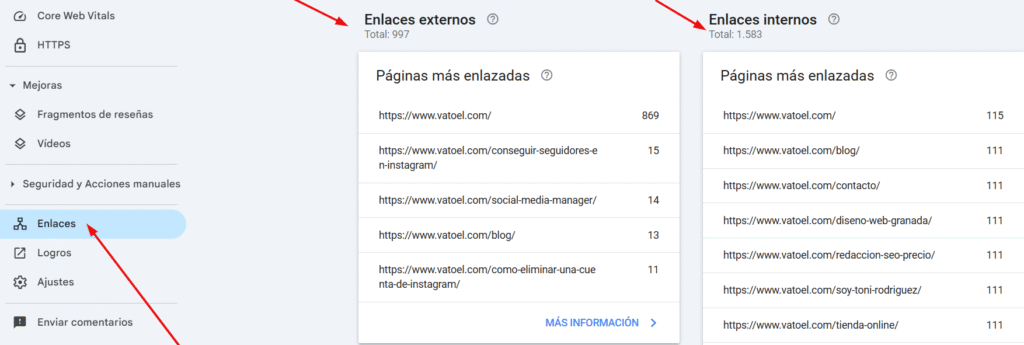
In your GSC dashboard, in the “Links” section, you can see a basic report of the backlinks pointing to your site. Among other data, it shows how many total external links you have, which of your pages are most linked and the most used anchor texts.
Bear in mind that GSC limits the number of links shown (the top 1,000 backlinks). Even so, it is a good starting point for monitoring your link profile.
SEO tools
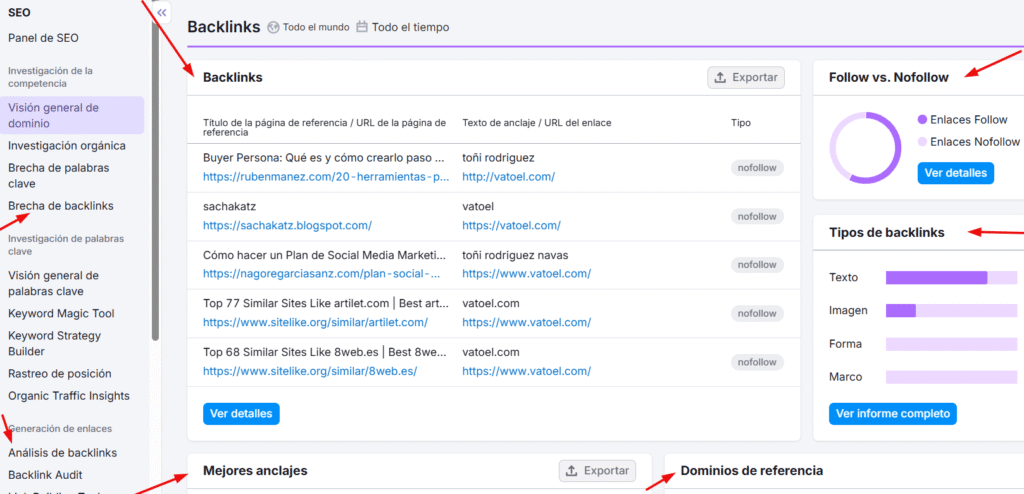
For a more in-depth analysis, there are SEO tools such as Ahrefs, Semrush, Moz and Majestic, among others.
These platforms have their own web indexes and let you look up practically all the backlinks pointing to a domain or page, together with useful metrics (domain authority, link type, anchor text, referring domains, etc.).
How to get quality backlinks
Before you start, it is essential to define your goals according to the time and resources available. From there, we can focus on what matters most: which strategies should you apply to get quality backlinks?
Create useful content
The most sustainable strategy is to produce content so good that other sites want to link to it naturally. Focus on creating linkable assets such as comprehensive guides, original studies, infographics, free tools, case studies, etc.
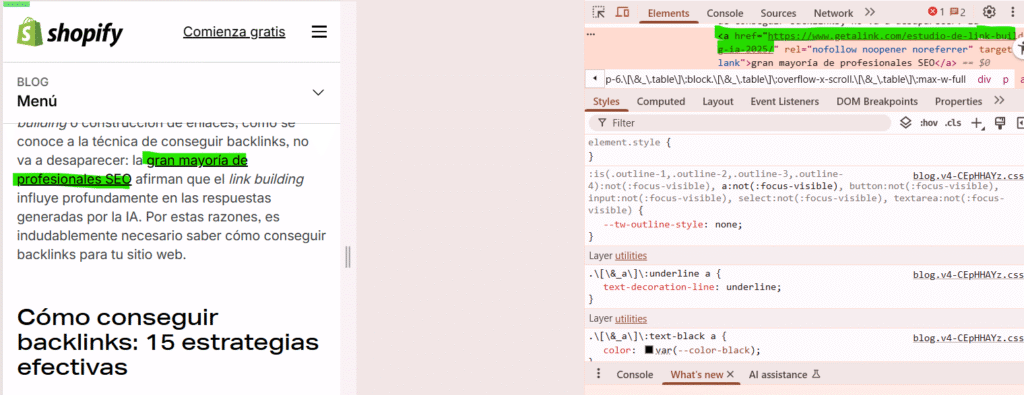
In the example image, you can see how Getalink's State of Link Building 2025 study was linked by the Shopify blog in one of its recent articles.
Promotion and proactive outreach
Outreach is a direct engagement strategy that consists of contacting other websites, blogs or media outlets to proactively earn links to your site. It is not enough to wait for people to link to you; you have to go out and ask for links.
When well executed, this strategy is one of the most effective ways to get quality backlinks, but also one of the most demanding, as it takes time to create content and contact the sites that suit your project. This is where Getalink can help you scale your backlink strategy without wasting time.
Get started nowOther outreach strategies are:
- Guest blogging: Offer to write a post for other blogs in your industry in exchange for including 1 or 2 links to your site. The key is to choose relevant, reputable sites and to provide original, useful content (not advertising).
- Broken link building: Identify broken links on other websites in your niche (for example, using tools or extensions that detect 404s). Then contact the webmaster suggesting they replace that broken link with one to your equivalent content covering the same topic.
- Skyscraper: The skyscraper technique in SEO consists of creating an improved version of a heavily linked piece of content in your industry and contacting those who linked to the original to suggest they link to yours.
- Unlinked mentions: Identify mentions of your brand without a link and contact the author to suggest turning the mention into a link. If the mention is already in a positive context, they may well agree to link.
- HARO (Help a Reporter Out) is a platform where journalists request expert opinions to complete their articles. If you respond with useful, relevant information within your industry, they may quote you as a source and include a backlink to your website. For example, if you have a nutrition blog and a major media outlet asks for tips on “nutrition for older people”, you can send your contribution and, if it is published, you will earn a quality link from a high-authority site to your website.
Use niche and local directories to get backlinks
Listing your website in directories in your own niche or area is another way to get quality backlinks.
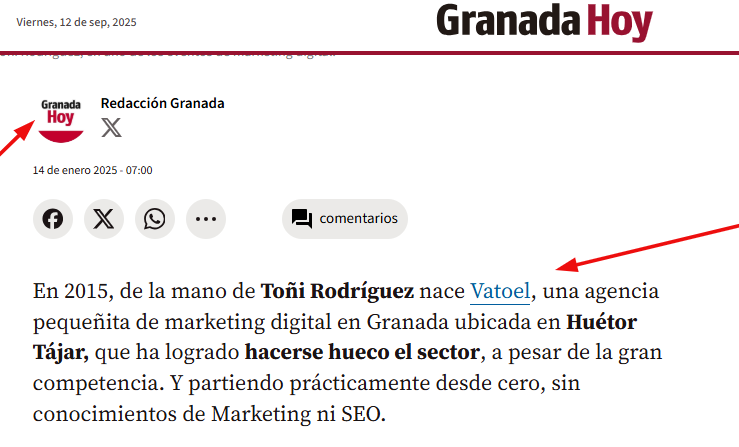
For example, links in local media and business directories mainly help local businesses gain visibility.
Likewise, taking part in online communities in your industry and in specialised forums or groups while adding value (not spam) will generate links to your content.
Analyse your competitors and look for “backlink gaps”
A very effective technique is to research which sites are linking to your competitors but not to you, and identify opportunities.
Tools such as Semrush's “Backlink Gap” let you compare your website's referring domains with those of your direct rivals.
Once you have identified them, you can send them a proposal. For example, if you have content that outperforms your competitor's on a certain topic, contact the site that links to it and show them your resource, explaining why they might be interested in linking to you.
Build relationships and partnerships
Behind every link there is a person who decided to create it, so having good relationships with other experts and bloggers in your niche can open the door to natural collaborations.
Ways to do this include engaging through comments on their blogs, sharing their content on social media and inviting them to take part in interviews, webinars, etc.
All these interactions can lead to those people mentioning or linking to you naturally in the future.
Which practices should you avoid when getting backlinks?
Not all backlinks are beneficial; some can harm your rankings because they violate Google's guidelines. Some examples you should avoid are:
Link farms or automation, as they are considered attempts to manipulate the algorithm and can lead to penalties.
It is also important to avoid forum and comment spam, where links are placed without adding any value. These types of backlinks are usually ignored by Google or, worse still, interpreted as a negative signal.
Low-quality links from untrustworthy sites (such as dubious directories or pages with a bad reputation) can also damage your profile.
In SEO, fewer but high-quality links are always better than lots of easy, suspicious links.
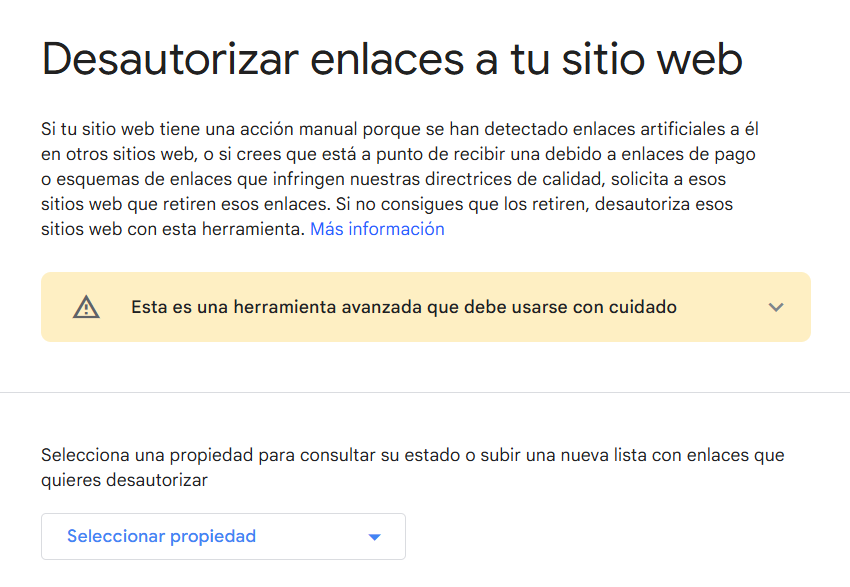
Finally, if you detect toxic links that you do not control, do not panic: as Google explains in its policies, it ignores them.
You can use Search Console's link disavow tool with caution, only when you are sure that the links are clearly harmful.
The importance of backlinks in the age of AI (artificial intelligence)
Although AI engines are changing the way information is presented, backlinks and referring domains remain one of the most solid pillars of online visibility and authority. According to a study by Ahrefs, there is a strong correlation between having numerous backlinks/referring domains and appearing in Google's top results.
Furthermore, analyses show that over 90% of AI Overviews include at least one page that already ranks among the top positions in the SERP.
Although AI tends to favour generated snippets and answers, these snippets still draw content from pages with proven authority. In this sense, backlinks have not lost value; they remain one of the most reliable signals when it comes to credibility and visibility in this age of AI as well.
Frequently asked questions about backlinks
How can I build a natural backlink profile?
A healthy link profile is based on quality, diversity and naturalness. Focus on creating useful, relevant content and on techniques such as guest posting, the skyscraper technique or personalised outreach. Make sure you maintain a variety of referring domains and avoid over-optimising anchor text.
Which practices should I avoid when building backlinks?
Always prioritise natural links obtained ethically. Avoid any strategy that seeks to manipulate Google's algorithm, such as generating mass links from low-quality sites. In the long run, these practices have a negative impact on your rankings and can even lead to penalties.
What results can I expect if I invest in a good backlink strategy?
Although results are not immediate, a well-executed backlink strategy brings benefits to your online project, such as improved positions on Google, increased organic traffic, greater domain authority and a stronger presence in your industry.
Do I need to buy backlinks or is creating good content enough?
Creating quality content should be the foundation of any SEO strategy. When content is useful, relevant and well optimised, backlinks tend to be generated naturally. However, if you decide to acquire links, it is essential to do so through specialised agencies that guarantee that the sites linking to you are high-quality and authoritative. This is the case with Getalink, which offers this type of service safely.
Request a quote for your backlink strategy
Shall we talk about your project?
Tell us what you need (full name, email, website, message) and we'll get back to you within 24 hours.
Send