

Backlinks remain one of the most important factors for ranking a website. The first step in building a quality link profile is understanding the different types you can get.
In this article we explain the types of backlinks and which ones you should prioritise depending on your business goals, budget and level of competition.
Types of backlinks by attribute
One of the key elements that influence how Google interprets a link is the rel attribute. This HTML attribute defines the relationship between the source page and the link's destination, and tells the search engine whether it should follow it, ignore it, or classify it as sponsored or user-generated.
Although these values do not completely block the link from being crawled, they act as signals that help Google's bots decide how to interpret it.
Dofollow links
Dofollow links are those that pass authority (link juice) to the linked site. They carry no additional attribute in their HTML code, as this is the standard behaviour; in other words, you don't need to write rel=”dofollow” because all links are dofollow by default.
For example: <a href=”https://tubacklink.com”>your backlink</a>
Nofollow links
A link with rel=”nofollow” tells search engines not to follow it or pass authority. Even so, nofollow backlinks help maintain a more natural link profile that is credible.
For example: <a href=”https://tubacklink.com” rel=”nofollow”>your backlink</a>
Sponsored links
The rel=”sponsored” attribute should be used in sponsored articles, paid press releases, banners or purchased links.
These backlinks don't usually contribute directly to SEO, but they can improve brand awareness and attract relevant traffic.
For example: <a href=”https://tubacklink.com” rel=”sponsored”>your backlink</a>
UGC links (User Generated Content)
Links with the rel=”ugc” attribute indicate that the content has been generated by users, as in blog comments, forums or reviews. Marking these links protects the website from possible penalties for spam content generated by third parties.
For example: <a href=”https://tubacklink.com” rel=”ugc”>your backlink</a>
Types of backlinks by price
Links can be obtained naturally, through collaborations and exchanges between websites in the same niche, and by buying sponsored posts and media appearances, among other types we are going to explain:
Free editorial backlinks
An editorial link is one obtained organically, without asking for it, paying for it or negotiating it. It happens when another website links to your content because it is relevant to them.
They are the type of backlink that Google, in its anti-spam guidelines, considers ideal. And you can earn them through case studies, infographics, practical guides and interviews that add value, enough to be linked (referenced) or mentioned.
Links bought in sponsored posts
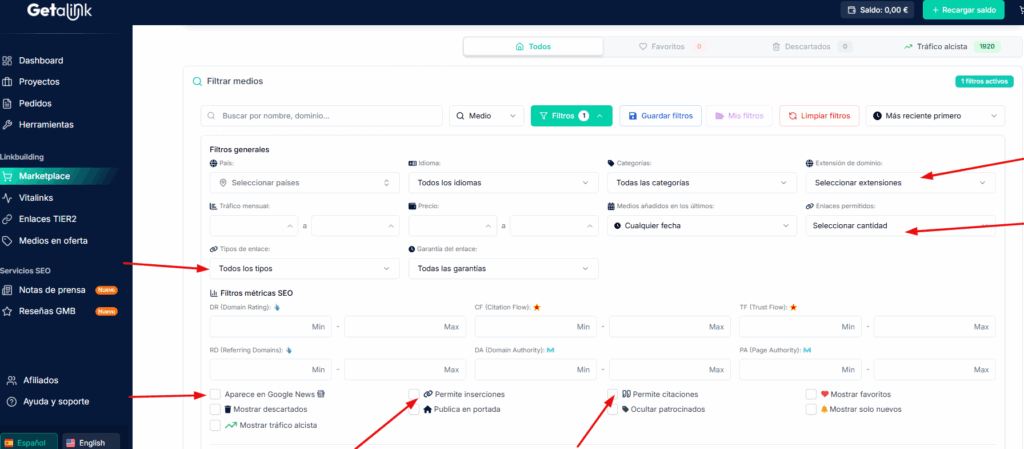
This type of backlink is obtained by buying links in media outlets, magazines or niche blogs through link building platforms such as Getalink, which offers more than 19,000 high-authority media outlets in over 30 countries where you can acquire quality links.
You just have to sign up and the “Marketplace” will appear with the available media outlets, where you can filter by link type, category (topical affinity), country, language, links allowed, price… And all that's left is to get the ideal link for your business.
Take note, because we have launched version 3.0 of Getalink, with new features such as filters and improvements like the new press release service, the new GMB reviews service, Vitalinks (traffic to published links), the improved project system (budget allocation) and the top 10 anchors for each media outlet.
This strategy will transfer domain authority to your website, which will generate brand awareness and credibility for your business.
Get started nowLink insertion
Another type of backlink is the one obtained by inserting links into articles that are already published and indexed. This link building strategy consists of leveraging a page's ranking to add your link contextually.
For it to be effective, you should choose pages that are relevant to your website and have real traffic. Use a natural anchor text that fits the content.
Once the strategy is defined, you can contact the chosen website and request the link insertion, or delegate it to Getalink, which offers a link insertion service on some of its media outlets.
Tier 2
Tier 2 links don't point directly to your website, but to other pages that already link to it (Tier 1), with the aim of strengthening their authority and indirectly improving your rankings.
They are cheaper than direct links and very useful in advanced link building strategies.
At Getalink, for example, they offer packs from 69,90 €, with premium and standard backlinks, unique content, no URL limit, choice of anchor text, guaranteed indexing and minimum metrics of DR/DA 20+.
Get started nowDigital PR links
Digital public relations (Digital PR) links are a type of backlink obtained through campaigns designed to generate media coverage, that is, an adaptation of traditional communications to the digital medium, with the aim of earning links.
Unlike other bought links or negotiated ones, these are earned by creating newsworthy content such as controversial statements, viral stunts or even a clickbait headline, which the media consider relevant to their audience.
For them to work, it is key to create an attractive story around your brand (rather than talking about the product itself); what matters is the story.
When they work, they generate links in top-tier media, brand mentions and great visibility; when they fail, they can mean a large investment with no return.
Link exchanges
Link exchanges are another type of backlink you can get, but you must do it properly, as Google penalises direct exchanges.
They are collaborations and mutual mentions between peers in the same sector or between clients.
To avoid penalties, for example, link from site A to site B in an article. From site B to another site C that is also yours or trusted. And from site C back to A.
Types of links by strategy
Depending on the strategy you carry out, links can be:
Links in guest posts
Links in guest posts are one of the most widely used types of backlinks, and consist of publishing content on external sites in exchange for including a link to your website.
However, in practice, most of these articles are low quality: generic texts, created with artificial intelligence, adding no value and with poorly placed links. For them to really work and provide real authority, they must meet certain requirements, such as:
- Being published on sites with a minimum of real authority and some traffic.
- Above all, there should be topical relevance to the sector.
- It is also advisable to place the link contextually, within the body of the text, surrounded by useful and coherent content. Producing a 400-word text with AI is not the same as creating slightly longer content that gives the link real value, with real examples and quotes; otherwise you will be wasting money and time.
These guest posts are very useful for diversifying your link profile so that Google sees it as “natural”.
For example: select between 10 and 15 truly relevant sites in your sector, identify and analyse outdated content or content gaps, and make proposals they can't refuse.
They work very well when you are launching a new website, as you need quality initial links.

HARO links
HARO links are a type of backlink obtained by sending expert quotes to journalists looking for sources for their articles.
Although today there is more competition and less quality than before, it remains an effective way to get natural, high-authority backlinks at no cost, ideal for strengthening EEAT and standing out in top media.
To do this you need an attractive identity, prepared quotes, filtering of DR60+ media, and follow-up to secure the link.
Although the success rate is somewhat low, when applied well it is a good SEO strategy for increasing potential customers' trust in your website.
PBN links
This type of link is obtained through a PBN, which is a cluster of websites in the same niche, created precisely for that purpose: to generate links between them.
They can deliver fast and powerful rankings, but carry a high risk if done badly or overused. A real PBN should be based on clean expired domains, replicate their original content, be hosted on dedicated IPs, be well disguised and be topically relevant.
To use them strategically, it is key to check the domain's history (no spam or toxic redirects) and publish quality content as if it were a real guest post.
Local citations
Local citations are mentions with or without a link, with name, address and phone number (NAP) in directories, maps or business listings.
They don't help affiliate pages rank, but they are essential in Local SEO, especially for improving geolocated visibility.
Their effectiveness depends on NAP consistency across all sites; in other words, the contact details must match in all the directories where you list your business. Add a link and a description, and optimise with images and reviews.
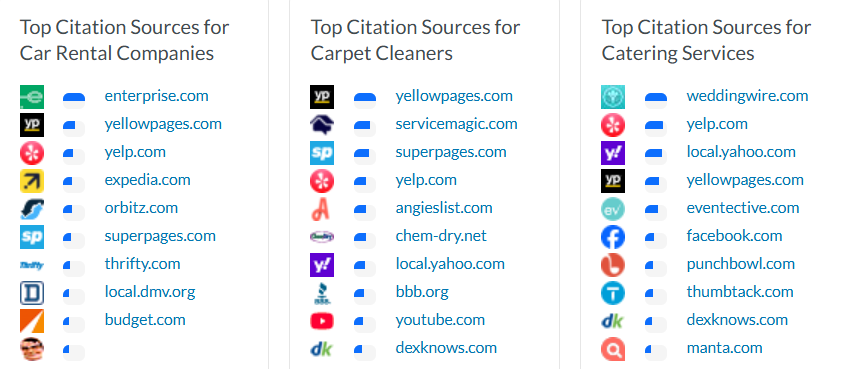
Some examples are Google Business Profile, About.me, Cilex, Yelp, FourSquare, etc.
On the MOZ website there is a local citations directory organised by the category of each type of business. We are sharing this resource as it can be very useful.
Forum links
Forum links are placed in the user profile or in the signature of each post. Although they usually have little direct SEO value, they are useful as tier 2 links to speed up indexing, reinforce other backlinks and generate brand mentions. The ones that work best are those added in the most active forums in your sector.
.EDU and .GOV links
The real value of this type of backlink lies not in its domain, but in the institutional trust it conveys. Used well, they strengthen your brand's credibility in Google's eyes.
The most effective methods include: creating fictitious scholarships to appear in university directories, proposing your website on resource pages, listing events in academic calendars...
The key to doing it well is to connect with the people in charge at the institution in a personalised way and use natural, branded anchor texts, not exact-match keywords.
Types of backlinks by their position on the website
Links within a website can be added:
Backlinks in text content
These are links inserted within the body text of an article or page. They have high SEO value because they are contextual, natural and relevant to the content. Google interprets them as genuine recommendations, which is why they are the most effective for passing authority and ranking.
Links in images
Image links are backlinks generated when other sites share or embed your images, crediting you as the source; they are useful for attracting traffic and gaining visibility.
For example, formats such as infographics or branded graphics with your URL. Use descriptive file names and optimised ALT text, and host the images on your root domain, distributing them in guest posts, forums or social networks.
Footer links
Footer and sidebar links were widely used some 6-8 years ago. Today, although they carry high risk, they can still be effective in small doses. A single sitewide footer link from a DR70+ site with real traffic can be worth more than several low-quality posts.
They work best for strengthening the home page, or simulating trust. Ideally, use a branded anchor and avoid spammy sites, mass links or exact-match anchors that could damage your profile.
Ideal types of links for each business
Each type of business requires a different strategy, depending on its model, goals and level of risk. That said, these examples can guide you in each case:
Local business: The ideal backlinks are local citations (NAP), guest posts aimed at local media, and listings in authoritative associations, chambers of commerce, etc., as they reinforce your geographical presence, increase visibility in local searches and consolidate brand trust.
Affiliates: You will need links that let you climb the rankings quickly without relying on original content, taking advantage of borrowed authority. So base your strategy on link insertions in existing articles that already rank, well-built PBNs, press releases, etc.
SaaS, B2B business: For this type of business you will need real authority and media visibility, so you should focus on high-level guest posts in technology media or SaaS portals, links in podcasts or interviews, etc.
Conclusions
If you've made it this far, you'll have seen that of all the types of backlinks, you may not even need 10… You'll only need to implement between 3 and 5 types of links that best fit your business model and budget.
And remember that the more natural and high-quality a link is, the more and better signals Google will receive, and it will reward you with an improvement in your site's authority and therefore in your SEO rankings.
Request a quote for your backlink strategy
Shall we talk about your project?
Tell us what you need (full name, email, website, message) and we'll get back to you within 24 hours.
Send