

If you run an online business, you've probably been hearing about Digital PR for a while now. If you're still not sure what it involves or how to implement it in your business, this guide is for you. We're going to explain everything you need to know, along with the Digital PR strategies that will help you dominate search results and generative AI answers.
What is Digital PR?
Digital PR (digital public relations) is the evolution of traditional public relations into the online environment. Its goal is to increase a brand's visibility and reputation through media coverage, mentions, quality links, and collaborations with journalists, blogs, specialist creators, and so on.
It isn't just about "getting into the media", but about earning credibility and authority signals that also strengthen your SEO.
Unlike traditional PR, which relies more on offline press, radio or television, Digital PR works across digital media, social networks, niche portals, podcasts and more. In other words, beyond earning links, it aims to build reputation and relationships.
Why is Digital PR important for SEO?
Because it connects brand visibility with organic authority. When a brand earns editorial mentions and links from relevant media outlets, it not only gains referral traffic but also strengthens how authoritative it is perceived to be in its sector.
Digital PR is one of the most effective and least "spammy" ways to earn quality links and strengthen brand signals.
What's more, as we know, Google always insists on prioritising helpful, reliable, people-first content, not content created solely to manipulate rankings. Its algorithm tries to identify signals related to experience, expertise, authoritativeness and trustworthiness (E-E-A-T), and among these elements, trust is the most important signal.
A well-executed digital PR strategy helps with exactly that: getting other trustworthy sites to talk about your brand, cite it and validate it publicly.
Get started now
What benefits does Digital PR bring to your business?
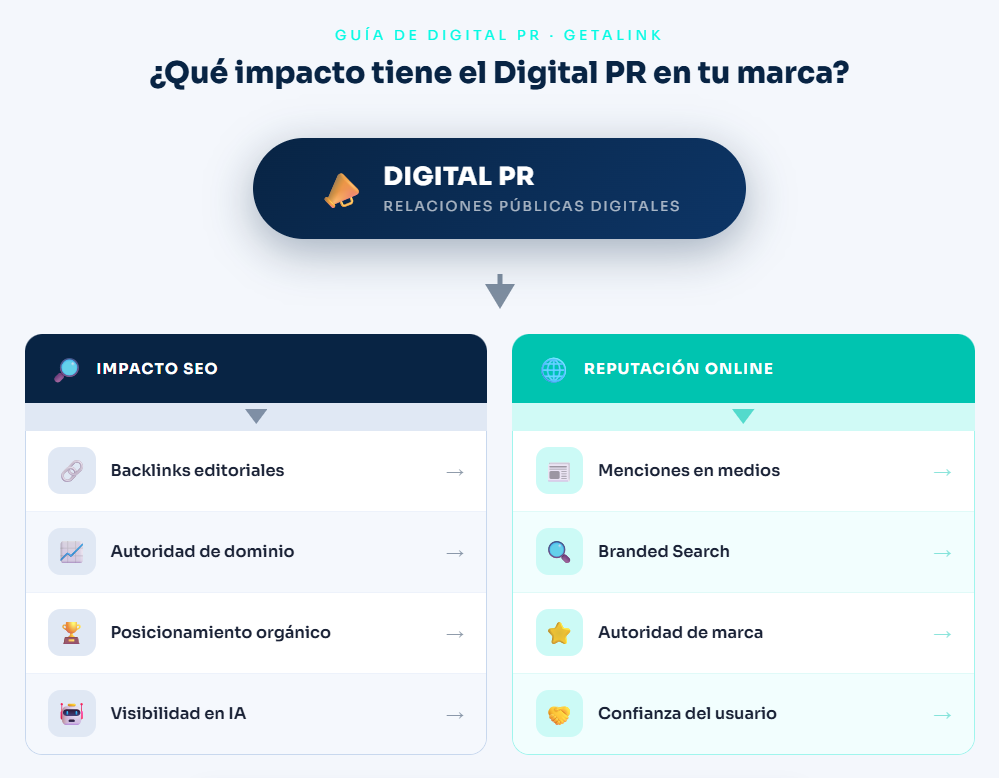
Some brands work on SEO and PR separately, which is one of the mistakes you should avoid. Digital PR is one of the most important pillars of off-page SEO, and its impact feeds directly into organic rankings. Here's why:
It builds authority and visibility
When a specialist outlet or a well-known blog mentions your company, your brand gains exposure and credibility. That coverage helps more people get to know you and see you as a benchmark within your sector.
Google places more value on these editorial links, as it interprets them as unique votes of confidence, for example, when a leading newspaper in your sector links to your website.
The result is an improvement in Domain Authority (DA) and, consequently, a progressive improvement in rankings for the keywords you want to rank for.
It strengthens E-E-A-T
EEAT (Experience, Expertise, Authoritativeness, Trustworthiness) is the set of criteria Google uses to assess the quality of a website and its content.
It isn't a direct ranking factor, but it does tip the balance in competitive sectors, especially in YMYL (Your Money, Your Life) niches such as finance, health, legal and so on.
So, how does digital PR contribute to E-E-A-T?
- Experience: Media mentions show that your brand has a genuine track record.
- Expertise: When journalists cite your company as an expert source, it reinforces your website's authority and topical relevance.
- Authoritativeness: Appearing in leading outlets in your sector builds authority.
- Trustworthiness: Editorial, non-advertising mentions build trust with both users and search engines.
Digital PR generates quality referral traffic
Backlinks earned through Digital PR don't just benefit SEO; they also attract direct and immediate traffic from readers who are reading that article on that outlet.
It's highly qualified traffic, because it comes from an audience that is already interested in your topic.
It improves your visibility in AI answers
ChatGPT, Gemini, Claude and Perplexity, among other AI search engines, draw on authoritative sources.
If leading outlets mention your brand frequently, LLMs will learn to cite you as an expert answer when a user asks about services or products in your sector.
In 2026, AI visibility is no longer the future; it's a reality that Digital PR can drive.
It boosts branded searches
Every time your brand is mentioned in an outlet, there's a real chance that the reader will later search for it on Google by name. That behaviour of searching for a brand directly because you've seen it cited in a trusted article is exactly what's known as branded search, and it's a signal the algorithm interprets as a synonym for relevance.
The more brand mentions you have in authoritative outlets, the more branded searches you get; and the more branded searches, the stronger Google's perception that your company is a benchmark in its sector.
It strengthens your business's online reputation
Digital PR isn't just about clicks or rankings; it also shapes how the public perceives the brand. An interview, a mention in a relevant outlet or the publication of your own study can accelerate trust-building and set you apart from the competition.
Crisis management, a key part of Digital PR
Just as building an online reputation is important, so is maintaining it over time. Crises can damage any brand, which is why good management can turn them into an opportunity to protect your reputation and reinforce trust among potential customers.
The key is to detect the problem early, define a clear message, respond quickly and transparently, and learn from the situation to come out stronger.
To do this, you can rely on Getalink's online reputation management service, which helps you manage how your brand is perceived and look after your digital presence. Book a meeting and we'll explain:
Get started now
It boosts other areas, such as marketing
Digital PR fits very well with content marketing, branding and social media. A single well-planned campaign can feed several channels at once: media and social networks will attract direct traffic, mentions and external links.
What isn't Digital PR?
Digital PR isn't sending out press releases en masse and expecting results as if by magic. Nor is it buying spam links. In fact, Google considers practices such as buying or selling links solely to manipulate rankings to be "link spam".
That's why a Digital PR strategy with SEO value must focus on earning coverage, not forcing it. The difference between a useful action and a risky one usually lies in whether there is real editorial value, journalistic interest and topical relevance for the outlet when it decides how to mention or link to the information.
How to implement Digital PR in an SEO strategy
Before looking for outlets or links, define a credible and consistent corporate communication strategy: what tone and values the brand wants to convey, which audience it's targeting, what sets it apart from the competition, and so on.
Set specific goals
A Digital PR campaign can pursue brand awareness, links to a strategic URL, presence in a sector's media, reputational reinforcement, support for a business category or growth in branded searches.
The important thing is not to measure success solely by the number of links, but by their real impact on visibility, authority and business.
Choose the right URL
Not everything should point to the homepage. As you know in SEO, it usually works better to link to assets that deserve to be cited, such as guides, studies, comparisons, resources, evergreen content, service pages and so on.
That way, the link makes more editorial sense and offers more value to the user.
Create a newsworthy asset
The campaigns that work best start from something the outlet can make use of, such as proprietary data, studies, lists, trends, real case studies and so on.
They're useful for earning media coverage, for example, research or trends on a relevant topic in your sector.
Select relevant outlets and contacts
It isn't about sending the same pitch to hundreds of sites, because Digital PR works best when you identify outlets, journalists and blogs aligned with the topic, the audience and the angle of the campaign.
Relevance matters as much as visibility.
Do outreach with an editorial approach
The message you send has to answer a very simple question: why does this story deserve to be published now? The clearer you are and the easier you make the journalist's or editor's job, the better your chances of securing quality coverage.
Optimise the landing page
The URL receiving the links must be ready to receive them. Google recommends creating helpful, reliable content with first-hand experience, clear sources, added value and a genuine purpose for the user.
It also warns against content created primarily to attract search engine traffic and against pieces that rewrite what others already say without adding value.
Amplify the coverage on your own channels
A powerful mention shouldn't stay only on the outlet that publishes it; it's worth reusing it on social media, in newsletters, on commercial landing pages, in presentations and sales materials, and working on internal linking from other related content.
The idea is to turn a one-off action into a longer-lasting asset for the brand.
Measure results
To evaluate a Digital PR strategy in SEO, in addition to link volume, you should take into account metrics such as the number of mentions, the quality of the backlinks, referral traffic, the organic visibility of the linked URL and its real impact on business objectives.
| Metric | What it measures | Tools |
|---|---|---|
| Number of backlinks | Number of links earned | Ahrefs, Semrush, Majestic |
| Domain authority | Increase in DA/DR after the campaign | Moz, Ahrefs |
| Backlink quality | Authority, traffic and relevance of the linking outlet | Ahrefs, Semrush |
| Referral traffic | Visits coming from the outlets that mention or link to you | Google Analytics |
| Organic rankings | Ranking trends for the target keywords | Google Search Console |
| Branded searches | Increase in branded searches (branded search) | Google Search Console |
| Media mentions | Total media coverage, with and without links | Google Alerts, Mention |
| AI visibility | Brand presence in answers generated by AI assistants | AI monitoring tools |
The Digital PR strategies that work best
The Digital PR strategies that work best for SEO are built on assets with real value for media and audiences, such as studies with proprietary data, industry reports, expert opinions and any content a journalist would want to cite because it provides context or useful information.
The key is to create original, verifiable and relevant pieces, since the more added value they offer compared with what already exists, the better their chances of generating legitimate coverage.
The optimal strategy will depend on the sector, the goals and the resources available. However, these are the tactics used with the best results:
Collaborating with digital media
The foundation of any digital PR strategy is building solid relationships with news platforms and specialist media in your sector. The goal isn't just to appear once, but to become a recurring source that journalists turn to when they need data or expert opinion.
To do this, distribute strategic (not generic) press releases that provide real value to the outlet's readers.
The Link Bait approach
Link Baiting involves creating content designed to attract links naturally, such as studies, guides on a specific topic, lists, free tools and so on.
Here's a table with the types of content that work best:
| Type of content | Description |
|---|---|
| Studies with proprietary data | Research with original or industry data that provides exclusive information that is easy for media to cite. |
| Free tools | Interactive resources such as calculators, generators or comparison tools that offer direct usefulness to the user. |
| Comprehensive evergreen guides | Long-form, timeless content that becomes a reference within a sector. |
| Infographics and data visualisations | Visual representations that simplify complex information and make it easier to share. |
| Statistics round-ups | Up-to-date lists of relevant data and figures on a specific topic. |
| Industry rankings | Rankings of products, companies or trends that generate interest and conversation in the sector. |
Newsjacking
Another Digital PR strategy is "Newsjacking", which involves taking advantage of a current news story or trend to offer your brand's perspective and earn mentions in the media covering that topic.
The key is speed, as there's a window of just a few hours between a story breaking and journalists covering it. To do it well, you need constant monitoring of industry trends, an agile content approval process and established relationships with journalists who already know you as a reliable source.
Strategic guest posting
Guest posting involves publishing valuable content on relevant blogs and media in your sector in exchange for a mention or link. When done with content that is useful for the host outlet's audience, it's one of the most effective and safest techniques as far as Google is concerned.
The key lies in choosing the outlet (topical relevance, genuine authority, organic traffic) and in the quality of the content (it should add value, not be a disguised advertorial).
Working with influencers
Collaborating with influential figures in your sector amplifies the reach of your message and generates mentions and links on platforms that traditional media don't reach.
Specialist micro-influencers (5,000-50,000 followers) tend to generate more engagement and credibility than generalist macro-influencers.
Presence in forums and communities
Taking an active part in the most relevant online forums and communities in your sector allows you to build authority, reach qualified leads and make contact with potential collaborators. Reddit, LinkedIn, Quora, specialist forums and Slack or Discord groups are places where a brand can demonstrate its expertise organically.
Events, webinars and podcasts
Organising or taking part in online events, such as webinars and industry podcasts, generates media coverage and mentions that translate into backlinks.
It also positions the brand's spokespeople as leaders in the sector, making it easier for journalists to contact them as expert sources in the future.
PR-based link building
And of course, this eighth digital PR strategy is a synthesis of all the previous ones, since analysing your competitors' backlink profiles lets you identify opportunities for relationships with media and bloggers to run a high-quality editorial link building campaign.
Here's a sample table to help you identify PR-driven link building opportunities:
| Step | What to do |
|---|---|
| 1 | Analyse the backlinks of your 3-5 main competitors |
| 2 | Identify which outlets and blogs link to them most often |
| 3 | Classify those sources by authority and topical relevance |
| 4 | Create a content asset that offers more value than your competitor's |
| 5 | Contact those outlets with a personalised, well-crafted pitch |
| 6 | Monitor the results and adjust the strategy based on performance |
The ideal media for Digital PR
You need to build a strategic list of the sites where your audience really is. These are the four main groups you can't do without:
- General news media: National titles, business newspapers and news portals with millions of readers. Their value lies not only in the traffic they can send you, but in the authority they pass to your domain when they link to you.
- Publications on sites in your sector: Niche magazines and professional associations. These are the sites where your potential customers go to learn and stay informed. A link from a specialist publication in your industry is worth far more than ten generic links.
- Blogs with their own audience: The links that really add value are those earned on blogs with a loyal community, which take care over what they publish and where a link to your website is a genuine recommendation.
- Creators and influencers with an engaged audience: YouTubers, newsletters with thousands of subscribers, LinkedIn accounts with high engagement or leading podcasts in your sector. Their content is crawled by search engines and, increasingly, cited by AI as a source of recommendations. Reaching them with a well-told story can multiply your campaign's reach in a matter of days.
Building and maintaining these lists is one of the most tedious jobs in Digital PR, and also one of the most decisive. If you'd rather skip that part and go straight to the results, at Getalink we have access to verified media so that your story reaches exactly where it needs to.
Get started nowPress releases: the best format for digital PR
If the four types of media above are the destination, the press release is the vehicle. It's the most established format in digital PR and remains the most effective entry-level tool for earning media coverage at scale.
But there's a fundamental difference between a press release that works and one that ends up ignored in an inbox: the ones that work aren't corporate statements padded with self-promotion, but informative pieces with a clear editorial angle, concrete data and a hook that answers the question every outlet or journalist asks when opening their email: why will my outlet's audience care about this?
A good, well-distributed press release can secure simultaneous presence in dozens of relevant outlets, quality editorial backlinks and an authority signal that Google processes directly.
What determines the real reach isn't just the content, but the distribution network. A release sent to ten generic outlets has a very different impact from the same release distributed strategically among outlets with real traffic, an engaged audience and established domain authority.
At Getalink you can launch your press release with guaranteed distribution across more than 50 outlets from €145, with copywriting included and inclusion in Google News. If you need greater reach, the higher plans include presence in titles such as Agencia EFE, Europa Press or Business Insider, among other outlets with proven authority.
Get started nowWhy choose Getalink for your Digital PR campaigns
Getalink's Digital PR service combines a journalistic approach with SEO precision to secure editorial mentions, media visibility and links in more natural and relevant contexts.
With more than 20,000 outlets and the option to publish in more than 120 countries, it offers plans with copywriting included, presence in Google News and up to 2 links per release, making it easier to scale awareness and authority campaigns with much more agile execution.
Not as a mass mailout of press releases, but as a work of research, creativity and purposeful content. This helps the brand gain not only backlinks, but also topical authority, branded searches, referral traffic and greater credibility in its sector.
If you want to appear in relevant media with a more natural, scalable strategy aligned with your brand, Getalink is the most recommended option for your Digital PR campaigns.
Frequently asked questions about Digital PR strategies
Is Digital PR only for big brands?
Not at all. Everyone from a startup with a limited budget to a multinational can implement Digital PR strategies. What varies is the reach and the target outlets. An SME can start with local and specialist media in its niche and achieve significant results with a reasonable investment.
What content works best in a Digital PR campaign?
Studies with proprietary data, trend analyses, expert commentary, industry reports and assets that provide real value to journalists, media and users work best.
How does Digital PR influence AI answers?
Generative AI tools (ChatGPT, Gemini, Perplexity) are trained on authoritative sources. The more your brand is cited by leading outlets, the more likely AI is to mention you as an expert answer. It's the new "first search result", and Digital PR is the best way to win it.
Does Google penalise Digital PR?
It doesn't penalise Digital PR; what it does go after is link manipulation practices.