

In the coming weeks, Ahrefs will roll out an update to its Domain Rating (DR) metric, which assesses the strength of a website's link profile compared with the others in its database.
DR4 will reach every account on 1 December 2026. From now on, a link is worth more if it comes from a site with real organic traffic, and subdomains no longer inherit the authority of their root domain.
If you run an ecommerce store or online business and buy links, DR is the metric most widely used to decide which publications to appear in. If the metric changes, so do the sites where it is worth getting links and the ones where it is not.
In this article we explain what is changing and what you should review in your link building strategy before the new DR4 system appears in your Ahrefs dashboard.
What is Domain Rating and what is it used for?
Domain Rating (DR) is the 0 to 100 metric Ahrefs uses to score the strength of a website's link profile against the rest of its database. It does not measure domain age or content quality.
DR is used as an indicator in the SEO reports that agencies and link building professionals deliver to their clients, and to choose which websites are worth getting links from. The switch to DR4 will change that figure, even though each site's links stay exactly the same.
What is Ahrefs DR4 and how does it differ from the current DR3?
DR4 is the fourth version of Ahrefs' Domain Rating, a score from 0 to 100 that measures the strength of a website's backlink profile. Ahrefs unveiled it on 5 November 2026.
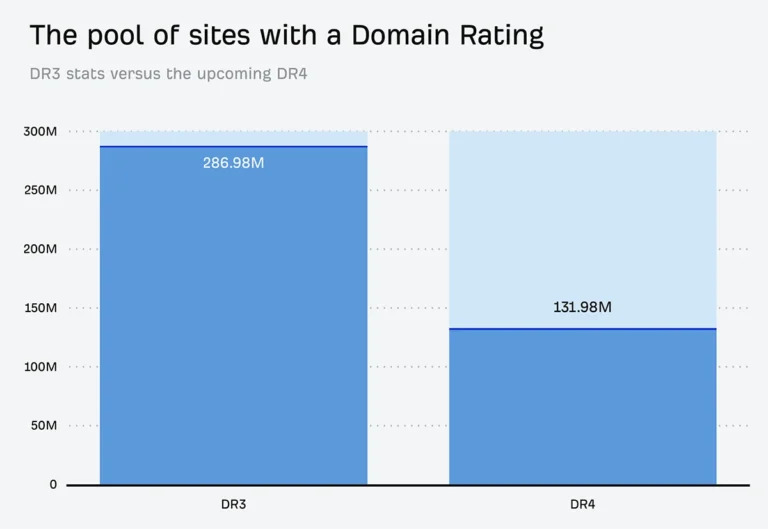
Although it still relies solely on links, it gives more weight to links from sites with estimated organic traffic, rates subdomains separately and cuts the number of rated sites from around 287 million to roughly 132 million.
| Current DR (DR3) | New DR (DR4) | |
| Which links are worth more? | Almost all are worth about the same | Those from sites that get visits from Google |
| Subdomains | Copy the DR of the root domain | Have their own DR |
| Sites with a DR | Around 287 million | Around 132 million (half), only the highest-quality ones |
| Correlation with Google's top 10 (0 to 1) | 0,140 | 0,359 |
Ahrefs has made this change because DR4 is closer to what Google rewards. Ahrefs analysed 10 million websites to measure how closely DR relates to Google rankings, using what is known as a correlation coefficient. It ranges from 0 to 1: 0 means there is no relationship at all between DR and rankings, and 1 means the relationship is perfect.
With DR4, the correlation with the top 10 rises from 0,140 to 0,359. Bear in mind that these are not percentages: 0,359 does not mean "35.9%". It indicates a moderate relationship, more than 2.5 times stronger than that of the current DR. That said, this figure comes with a caveat and depends on the type of site:
- Root domains, such as yourshop.com, which is the case for most SMEs and online shops. Here the current DR is still slightly more accurate than the new one. In Google's top 3, the correlation is 0,382 with DR3 and 0,295 with DR4.
- Subdomains, such as blog.yourshop.com or blogs hosted on platforms like Blogspot or Notion. Here the correlation rises from 0,126 with DR3 to 0,225 with DR4, almost double. That makes sense, because until now a subdomain copied the DR of its root domain even if it did not have a single link of its own.
And under no circumstances is DR something Google uses for rankings; it is purely an Ahrefs metric.
Finally, climbing in DR still gets harder the higher you are. Going from 84 to 85 is much harder than going from 54 to 55.
How can you see your DR4 score before it goes live in Ahrefs?
You can check DR4 right now, as Ahrefs has opened a demo page that lets you do so:
detailed.com/dr-v4/
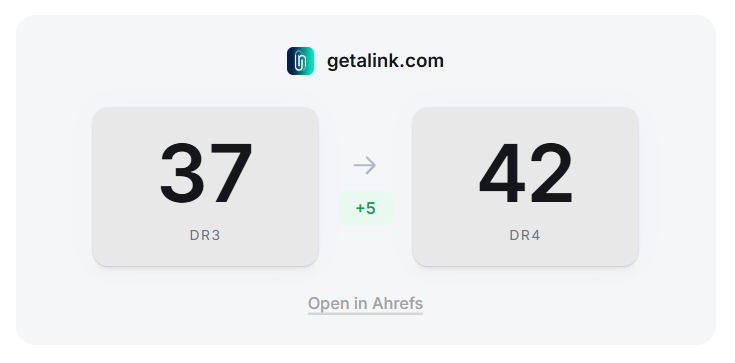
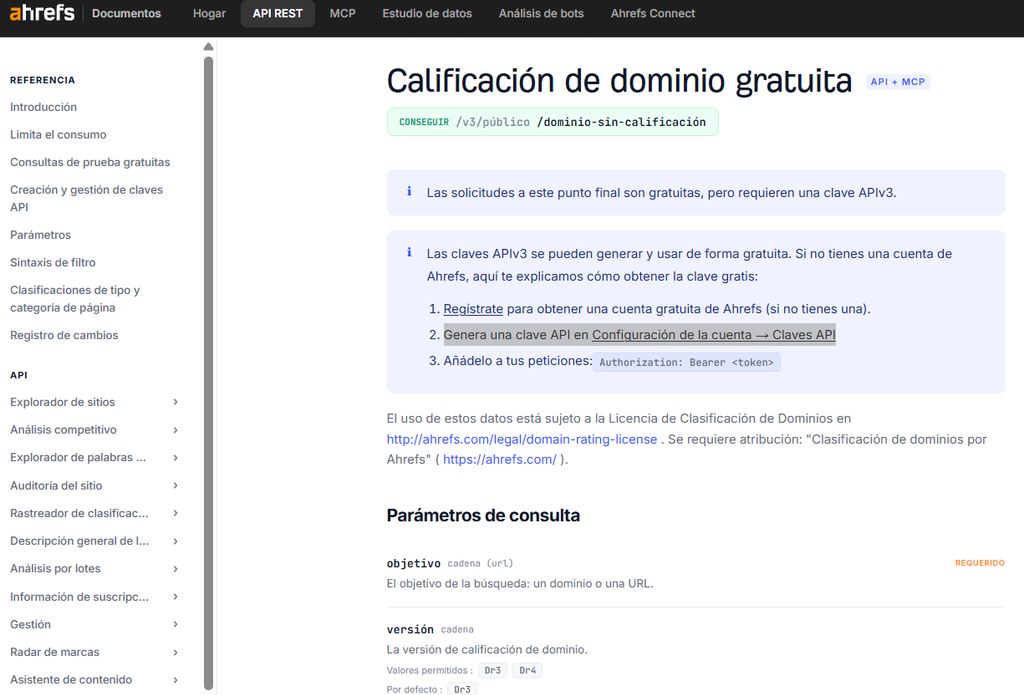
You can also use the free Domain Rating API to check many domains at once. For example, to see all the publications where you have been featured:
- Create a free Ahrefs account and generate an API key from your account settings. No paid plan is needed.
- Generate your API key: Go to your account settings, in the Ahrefs API keys section.
- Run the query: Add the parameter
version=dr4to get the new DR. If you leave it out, it will return the current DR3.
Which websites gain and which lose DR with this change?
Among the 1,000 most visited websites in the world according to Ahrefs' organic search traffic estimates, 64.3% saw their DR increase, 15.8% stayed the same and 19.9% dropped, with a median fall of just 4 points.
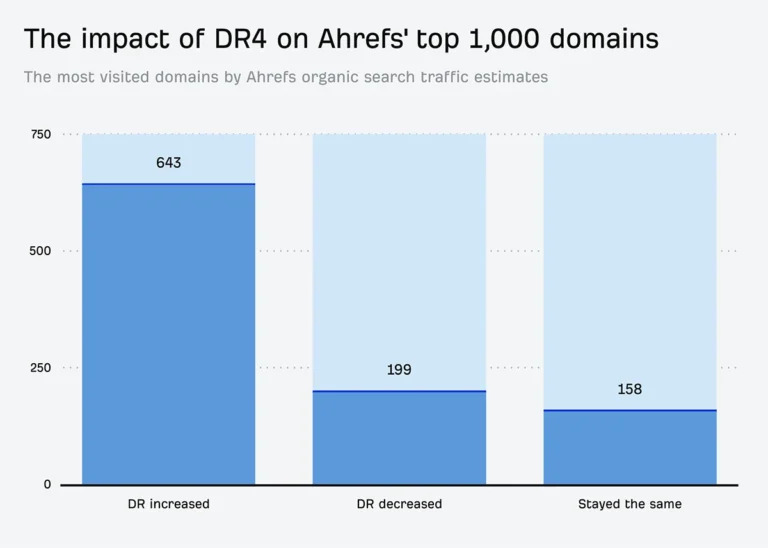
Most reasonably serious, professional websites will barely notice the change. The sharp drops are concentrated in three types of site:
- Sites flagged as spam: Those that had a DR between 30 and 70 lose a median of 15 to 20 points.
- Subdomains living off someone else's authority: A blog set up on a Notion or Hostinger subdomain used to have the platform's DR 92. With DR4, those subdomains fall to DR 0 or 2.
- Sites with no real traffic: If a site has lots of links but hardly anyone finds it on Google, its links carry less weight and its DR goes down.
Here are some examples of subdomains:
| Subdomain | DR3 | DR4 |
|---|---|---|
| help.ahrefs.com | 91 | 75 |
| play.google.com | 100 | 96 |
| blogs.microsoft.com | 96 | 89 |
| finance.yahoo.com | 94 | 92 |
| blogs.oracle.com | 93 | 86 |
| insights.samsung.com | 92 | 74 |
| example*.hostingersite.com | 92 | 1,9 |
| example*.notion.site | 92 | 0 |
So if you buy links and the publication publishes on a subdomain, look at that subdomain's DR, not the root domain's.
On the other hand, publications and blogs with organic audiences, online newspapers, trade magazines and niche sites that get genuine visits will not lose DR. They are exactly the kind of publication we work with at Getalink.
Watch your DR: If it drops, it does not mean you have done something wrong or that you are going to lose rankings. DR4 is a new way of measuring by Ahrefs, not a Google penalty. The difference reveals the quality of your links, which is very positive for your link building campaigns. It will help you fine-tune your choice of the publications that matter most to you.
Ahrefs DR4: how it affects your link building strategy
From now on, when choosing a publication you will need to look at organic traffic as well as its Ahrefs DR, as traffic becomes just as important as authority.
A link from a DR 50 publication with thousands of visits a month can be worth more than one from a DR 70 site with no traffic.
Before buying a link, always check these four points:
- Real organic traffic: Check that the publication gets visits from Google and that the trend is not downward.
- Root domain or subdomain: If the article is published on a subdomain, look at that subdomain's DR, not the root domain's.
- Topic: A publication in your sector gives Google and AI more context than an unrelated general-interest one.
In the Getalink marketplace you can see this data for every publication before you buy: Ahrefs DR and organic traffic, country, language and link type. That way you can filter for publications with real audiences, which are the ones Ahrefs DR4 rewards (based on what Google rewards).
Get started nowGetalink extension to check any publication while you browse
With the Getalink extension you can check any publication while you browse without leaving Google. When you visit a website available on Getalink, the extension shows you the publication's data, its DR and organic traffic from Ahrefs, the link type (follow, nofollow) and the price of each format: sponsored article, link insertion or brand mention.
It also highlights the available publications in Google results and AI assistants. In Google and AI assistant results, the Getalink logo appears next to the available publications. Hover over it and you will see their data without visiting the site.
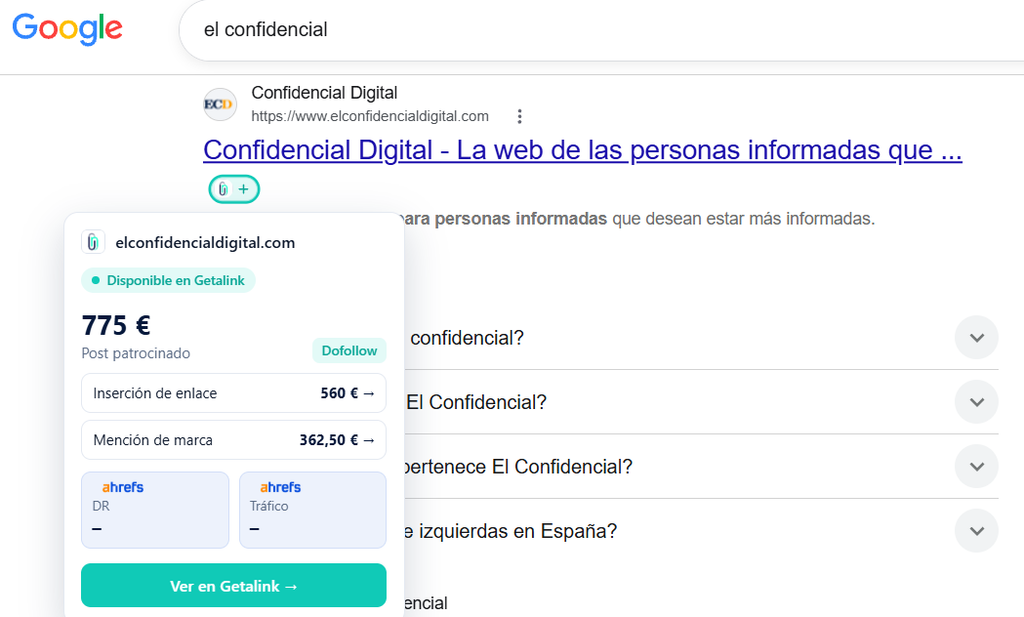
One click takes you to the publication's page on Getalink to place your order.
And if a website is not in the catalogue, you can ask us to contact it with just your email address.
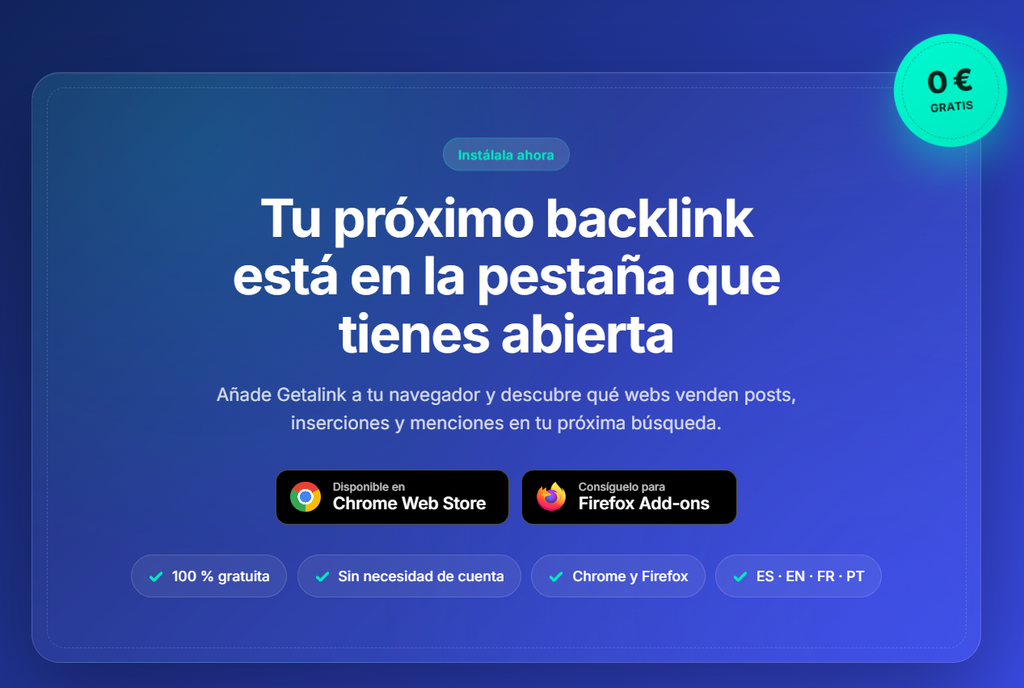
It is free, you do not need a Getalink account and it works on Chrome, Firefox, Edge and Brave. You can also use it in 4 languages: Spanish, English, French and Portuguese.
Install the Getalink extension for free
What should you do before 1 December?
If you log in to Ahrefs and see that your DR has dropped, there is no need to panic. It is a signal to review your link profile, not a ranking problem in itself. These are the steps we recommend:
- Save your DR4 as a baseline before the change: Use the Ahrefs demo to record your new score and that of 3 to 5 competitors, with the date and a screenshot.
- Do not compare November's DR with December's: DR3 and DR4 are different metrics. If you receive SEO reports, ask them to state which version they use. And if you are the one presenting results to clients or to your company, let them know about the change now. If DR goes up or down in December, it will not be because of your work or your agency's, but because Ahrefs has rolled out DR4.
- Identify which links have lost value: Check whether some of your authority came from sites with no traffic, free subdomains or sites flagged as spam.
- Make sure your best links are still live: A link that has been removed or switched from follow to nofollow stops adding value, and with DR4 every quality link carries more weight.
- Strengthen with quality publications: Replace the weight of weak links with placements in publications that have an organic audience and a related topic.
Keep an eye on your links with Getalink's Backlink Monitor
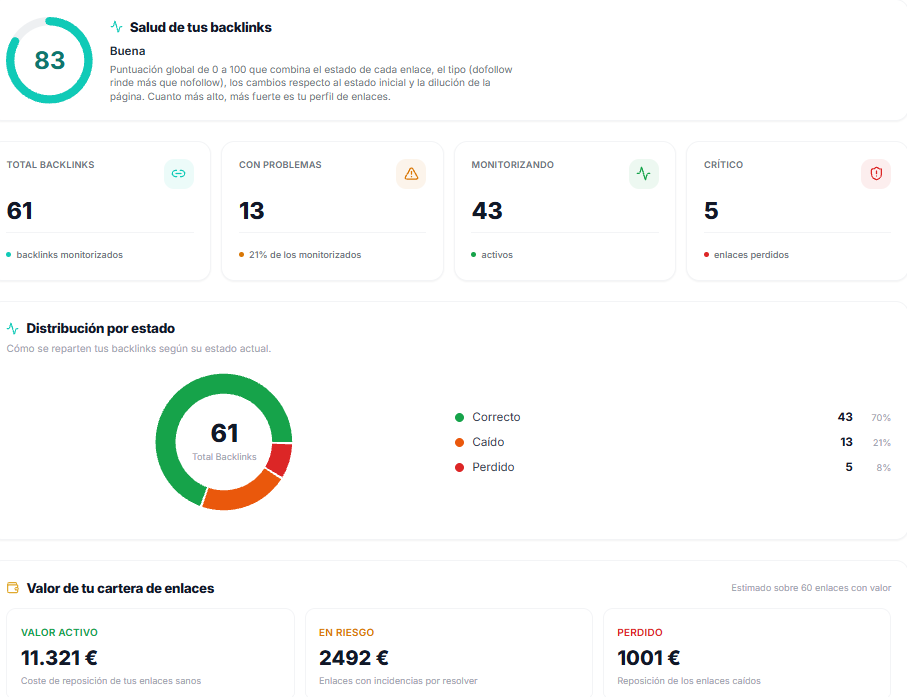
You can protect your links with Getalink's Backlink Monitor. Links get lost all the time: a publication redesigns its website, deletes old articles or changes link attributes without warning. If you do not spot it, you are paying for a link that no longer exists.
With Backlink Monitor you have all your links under control in a single dashboard. The tool regularly checks that each link is still published with the correct attribute and alerts you as soon as something changes so you can claim it in time.
Start monitoring your backlinks
Why does digital PR come out stronger with the new DR4 system?
DR4 rewards exactly what a good digital PR strategy achieves: links and mentions in publications with real audiences. Online newspapers and trade magazines have stable organic traffic, publish on their root domain and are almost never flagged as spam.
- Authority for Google, with links that the DR4 metric values more highly than DR3 did.
- Social proof for your website, as it builds trust and improves conversion.
- Trusted sources for AI: ChatGPT, Gemini and Perplexity rely on recognised publications to decide which brands to cite.
No time to manage it? Leave it in the hands of an expert
Analysing your link profile, researching publications, comparing traffic and prices, negotiating and following up all takes time. With our Managed Link Building Service, a Getalink expert takes care of the whole process:
- Analysis of your project to identify the keywords with real business potential.
- Selection of quality publications: Newspapers, blogs and sites relevant to your sector, with real organic traffic.
- Tailored strategy, aligned with your SEO and brand goals.
- 360º management, from research through to publication and monthly reporting.
The basic plan starts at 400 € per month and includes an initial strategy meeting, publication selection, link placement and a detailed monthly report.
Get started nowAhrefs' new DR4 system confirms something we at Getalink have always championed: a link is worth as much as the publication that hosts it, and a publication is worth as much as its real audience.
Request a quote for your link building strategy
Shall we talk about your project?
Tell us what you need (full name, email, website, message) and we'll get back to you within 24 hours.
SendFrequently asked questions
When will DR4 be available?
On 1 December 2026 it becomes the DR you will see by default in Ahrefs. For a short period, the API will still let you query the old DR.
If my DR drops, will I lose Google rankings?
No, DR is an Ahrefs metric, not a Google one. If it drops, it indicates that some of your links come from sites with little traffic or low quality, and that is worth fixing.
Will the DR of the publications I buy from change?
Yes. Publications with real organic traffic will maintain or increase their DR, while sites with no audience or flagged as spam may fall considerably. That is why now is a good time to review the publications you work with and look at their traffic as well as their DR.