

If you publish frequently and keep your blog content up to date, but you are not seeing much improvement in your rankings, you may not be taking advantage of content gaps.
This SEO strategy is based on creating useful content in order to strengthen your unique value, increasing the chances of attracting organic traffic to your website.
In this article we explain what it is and how to run a content gap analysis:
What is a content gap?
A content gap (content shortfalls) is any topic, keyword or content format that your audience is looking for and cannot find on your site, but can find on your competitors' sites. It is essentially a piece of strategic value for your business that needs to be covered in order to satisfy the user's search intent.
These content gaps need to be filled on your blog to improve your rankings and visibility. They can be keyword gaps, topic gaps or media gaps.
Keyword gap
Keyword gaps (missing keywords) are the keywords your competitors rank for but you do not. That is precisely why you should include them in your content.
Add long-tail keywords, as they have less competition and will therefore be easier to rank for.
Empty topics or topic gap
These are the important topics you have not yet covered in your blog content, which represents an opportunity to add new content.
Empty media
A website does not rank on copy alone: use images, videos, infographics, comparison tables, podcasts or other formats that your audience values but that are not yet being offered.
What is a content gap analysis?
It is the process of uncovering content opportunities through keyword gaps, so that you can add them to your website and try to outperform your competitors.
This analysis gives you information about:
- The keywords your competitors rank for that you are not using.
- The keywords you rank for but your competitors do not.
- The keywords your competitors have in common.
Create new content and improve old content
Once you have identified the content gaps, it is time to get to work. Whether by creating new articles or improving existing ones, the goal is clear: to appear on the first page of Google.
– Fill the gaps: Create original content that is more comprehensive and up to date than your competitors'.
– Optimise the content for SEO: Use keywords strategically in the copy, images, headings, metadata and body text.
– Vary the formats: Add infographics, videos or real case studies to stand out from competitors that only use text.
Take Google's E-E-A-T factor into account
I will also tell you that, to close a content gap properly, it is not enough to copy your competitors' keywords. You need to build content that reflects the knowledge, authority and credibility (E-E-A-T: experience, expertise, authoritativeness and trustworthiness) you have on a specific topic.
This is how you gain topical authority and better positions on Google.
How to run a content gap analysis with Rankerfy – Content gap
With the SEO tool Rankerfy you can compare domains using its "content gap" module. Enter your website URL and, below it, two or three of your competitors' domains. Click the "search" option.
The tool returns a list of common, missing and unique content keywords. In other words, the keywords both domains share, the ones your competitors rank for and you do not, and the unique content keywords, which are the ones you have and your competitors do not.
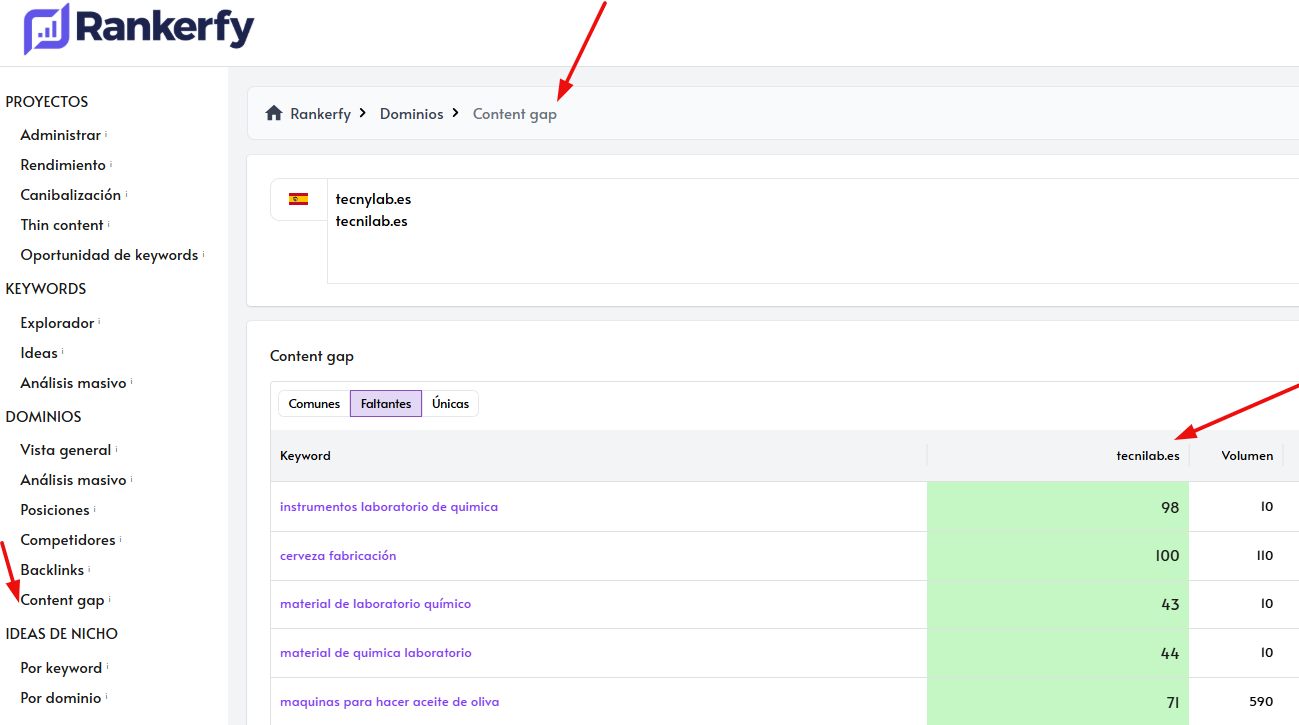
A very useful content gap analysis that will tell you which keywords you should add to your SEO content strategy.
Here is an example video that explains it:
Example: Content gap analysis with Ahrefs
To analyse content gaps you can use any SEO tool that offers this feature. In this case, we are going to use Ahrefs so you can see how easy it is to outperform the competition.
– The first thing you need to do is go to the "Competitive Analysis" option and select "keyword".
– You will see a dialogue box like the one shown in the image
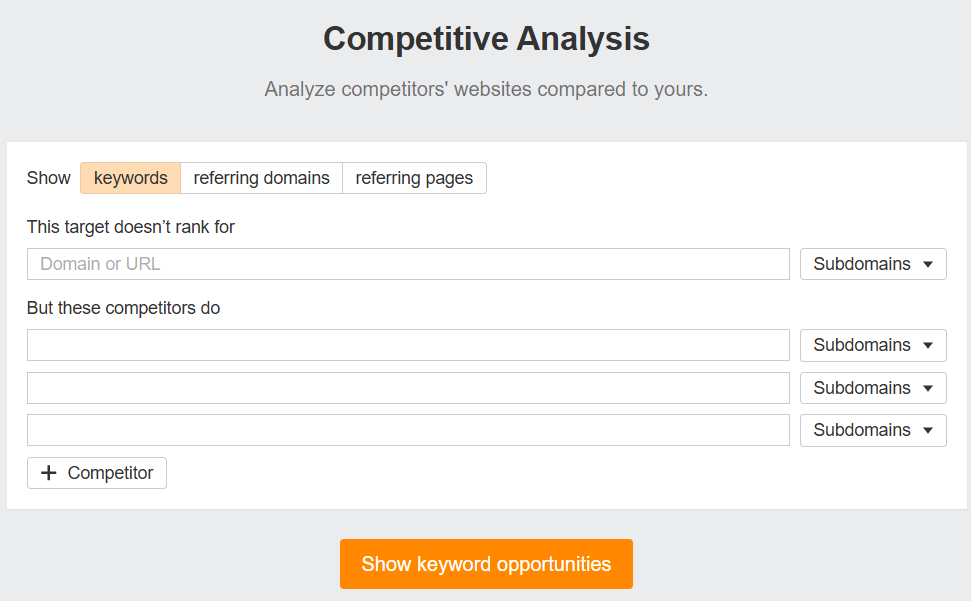
Next, add your domain at the top and those of two or three of your organic search competitors. If you do not yet know which domains are your competitors, the competitive analysis tool suggests them automatically.
The tool returns a "content gap" list with the keywords your competitors rank for and your website or online shop does not.
You can enable the "Main positions only" option to exclude from the list positions in AI Overviews, sitelinks, images, videos, forums and posts on X (Twitter).
If the list contains thousands of keywords, you can, for example, use the volume filters from 20 upwards and select the top 100 keywords to start working from there. You can also filter by keyword difficulty (KD).
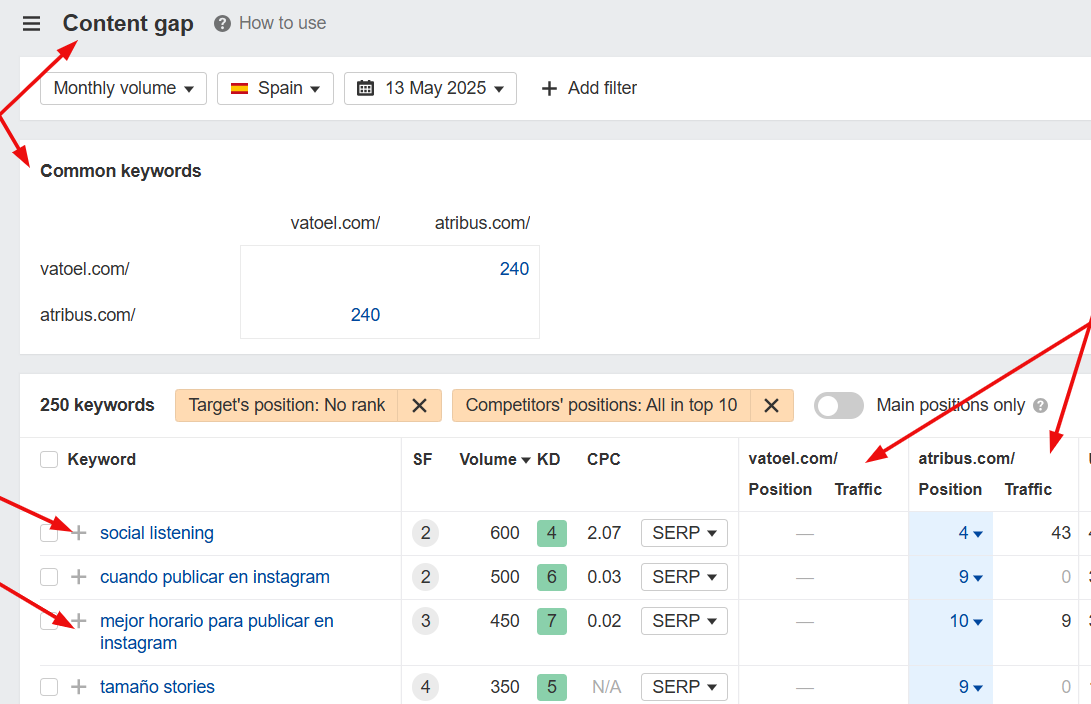
Then exclude the columns you are not interested in and export the list.
Content gap analysis template
Now paste it into the Ahrefs Content Gap Analysis template it gives you for free, ready to copy.
You now have the opportunity to fill the content gaps with content for your page or articles for your blog on these keywords, aiming to improve on your competitors' content so that Google notices the improvement and ranks your site for those keywords.
Domain and page gap analysis
In addition to the keyword gap, two other options appear: referring domains and referring pages, which you can also select.
Domain-level gaps: these occur when your website does not address topics that your competitors have covered extensively. This indicates that you are missing opportunities to rank for relevant topics within your niche.
Page-level gaps: these occur when you and your competitors have content on the same topic, but their pages rank better because their content is more comprehensive or of higher quality, capturing more keywords and therefore more traffic.
For example, imagine an analysis shows that a competitor's page ranks for 25 keywords on a topic you also cover, but your page gets no visibility.
So what should you do? First, check whether you already have a page on the topic. You can use this command in a Google search:
site:xsitio.com "keyword"
If you have one, optimise it by adding the missing keywords that came out of the analysis; if you do not, create a new page focused on that topic.
Make sure you improve the content (not just add keywords) with useful explanations, definitions or sections that answer the user's search intent.
This will allow you to close those gaps, improve your rankings and attract more qualified traffic to your website.
Alternatives for spotting content gaps
In addition to the tools mentioned above, there are others we can use to detect content gaps from different angles: from keyword comparisons to performance analysis and visualising user questions.
SEMrush (Keyword Gap Tool, Topic Research)
It lets you compare your domain with up to four competitors to see common and unique keywords, and those they rank better for than you.
It offers advanced filters for volume, difficulty and match type, and makes it easy to export the data for further analysis.
DinoRANK Content Gap
With a simple interface, this tool lets you find content opportunities to improve the SEO of your online project. It allows you to compare your domain with those of several competitors to identify the keywords they rank for and your website does not.
This will build more expertise in Google's eyes so your content ranks better. You can try it for half the price of Ahrefs.
Google Trends to identify emerging topics
It shows how search interest evolves in real time or historically, by region and category, allowing you to spot rising trends before they become saturated and steer your content towards topical subjects.
Google Search Console (Search queries, performance)
Its performance report shows the queries that generate impressions and clicks, the average position and the breakdown by device and country, helping you spot keywords and pages with untapped potential.
AnswerThePublic / AlsoAsked (Visualising user questions)
These "search listening" tools pull data from autocomplete or from Google's People Also Ask to display, in charts and trees, all the questions and related terms users search for on a topic, revealing content opportunities centred on the user's real intent.
Final conclusions
Content gaps are the essential starting point for an effective content marketing strategy. Identifying and covering these shortfalls allows you to connect better with your audience, position yourself against the competition and build a solid foundation for optimised SEO copywriting.
In turn, good SEO content (as we discussed in previous articles) is the foundation for developing effective link building campaigns that boost your visibility and authority in search engines.
Request your quote and start generating quality links for your website.
Request a quote for your backlink strategy
Shall we talk about your project?
Tell us what you need (full name, email, website, message) and we'll get back to you within 24 hours.
Send